ChatGPT is one feature away from replacing Slack
This dev log is about Inselnova: one island, sea wars and alliance politics in a world that never resets. Play free →
TL;DR: Slack isn’t dying. Salesforce just reported its fastest new-order growth since it bought it. I still think ChatGPT replaces it, because the centre of gravity of work is moving into the conversation with the AI, and a ChatGPT thread is already one person short of a Slack channel. OpenAI tried group chats and pulled them, which I read as not ready rather than not interested. Once other people can join a thread, the place I talk to my AI becomes the place I talk to my team, and Slack, Jira, Linear and everything else built as a screen on top of the team’s data has a rough few years ahead.
Slack stopped moving years ago
Slack has belonged to Salesforce since 2021, and it’s doing fine. Salesforce says it just had its fastest new-order growth since the acquisition. None of that changes my mind, because the product stopped changing years ago. The interface looks the way it did five years ago. The API, the app framework and the admin side haven’t moved much either. Try setting up a Slack app. It’s a confusing mess, it has been for years, and a company still trying wouldn’t leave its front door for developers in that state. My guess is the resources go to enterprise customers, because that’s where the money is, and nothing has forced anything else. I loved HipChat, I thought it was more powerful, and it never got the traction it deserved. Slack took the stage and then stayed where it was standing.
So my bet is this. ChatGPT doesn’t need Slack to fail. It replaces Slack because the container for work becomes the conversation with the AI, and the chat app becomes a feature of it. Slack’s numbers will look fine right up until the quarter they don’t.
Work mode is already a chat window
OpenAI has been busy in exactly this space. In April, Workspace Agents replaced custom GPTs: agents that run on a schedule, can be added into Slack, read the channel they’re in, and go off and do work. In July, ChatGPT Work: a mode next to Chat that takes a goal, plans the steps, and runs them on a cloud VM that keeps going when your laptop is closed, with plugins into Slack, Gmail, Drive, Salesforce and GitHub. It’s in the Plus plan. My daily property news digest at work is a scheduled ChatGPT task, and it posts into our #news channel every morning under my name with “Sent using ChatGPT” on the end.
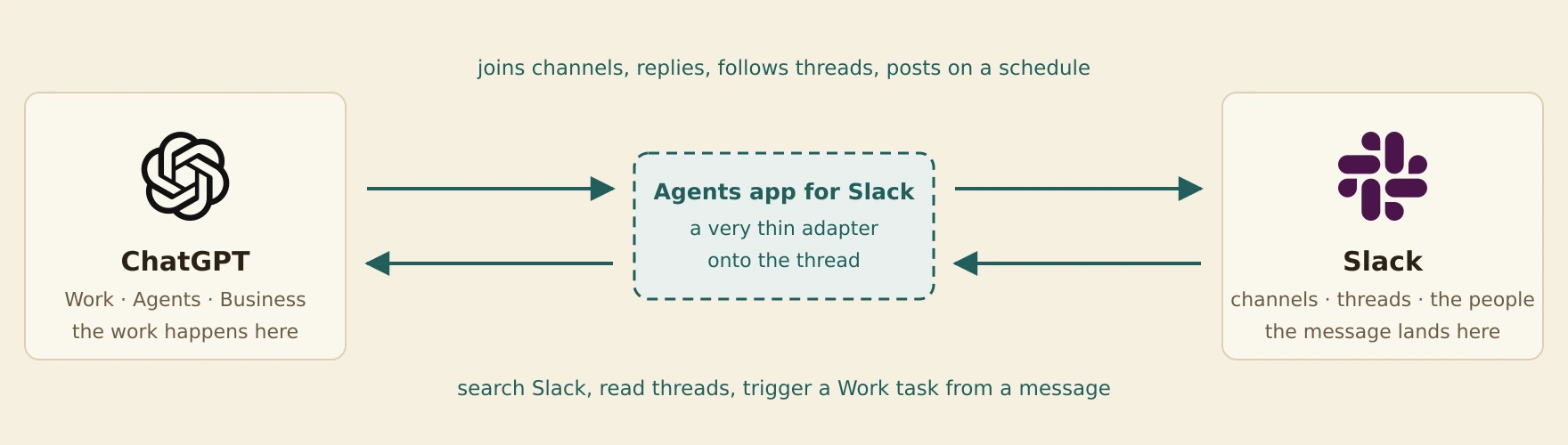
And it goes both ways. The ChatGPT Agents app for Slack can join channels, reply when mentioned or when a message is relevant, follow a thread, and post scheduled messages. I’m sure it’s a very thin thread adapter, and that’s the point: the work happens in ChatGPT and Slack is just where the message lands. From inside ChatGPT you can search Slack, read threads, join channels, and trigger a Work task from something that happened in a channel. ChatGPT Business already has the workspace, roles, SSO, company knowledge, apps, Codex, desktop and mobile. Every piece of a work platform is there except one.
A ChatGPT thread is one person short of a channel
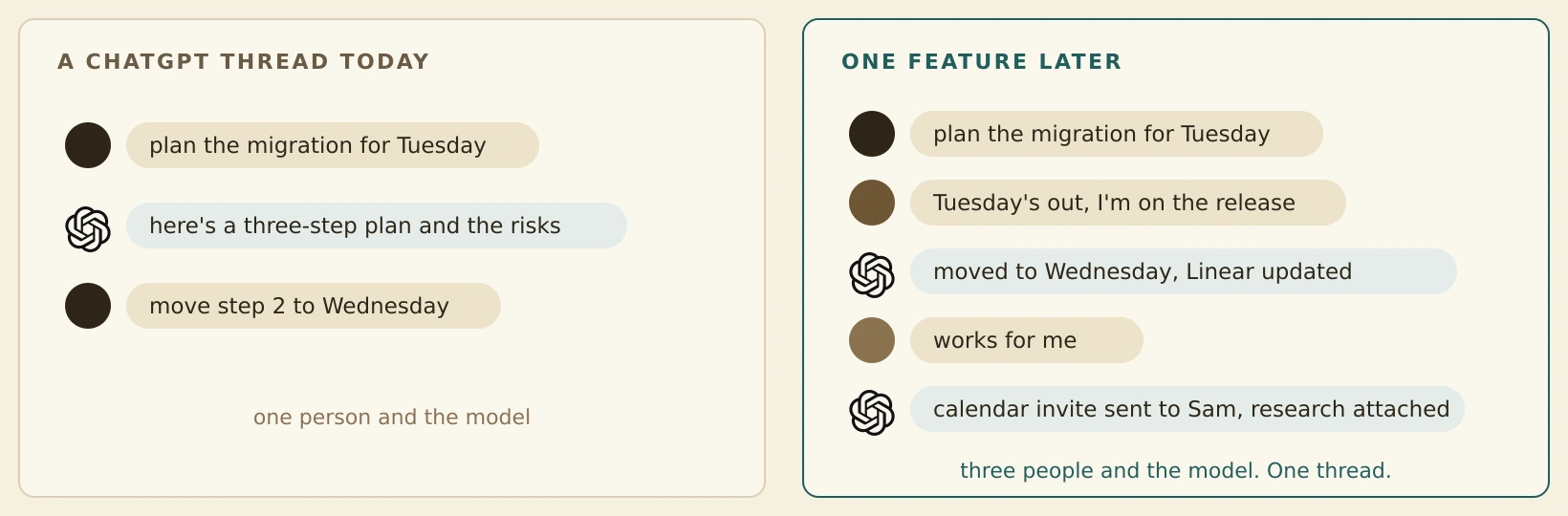
A ChatGPT thread is basically a room already. It’s persistent, it has history, the model is in it, and you can share it. What it doesn’t have is the other people. Put three of us and an agent in the same thread and you don’t have a chatbot with a Slack plugin, you have Slack with the model built in.
The awkward fact is that OpenAI had this and deleted it. Group chats launched in November 2025: up to 20 people in one conversation, @-mention ChatGPT. I’d forgotten it existed, which is probably the point. On 9 July 2026, the same day Work launched, they retired it, replaced with a DM-style Messages tab. swyx, who wrote Why OpenAI Should Build Slack in February, noted at the time that usage outside OpenAI itself was low.
My read is they pulled it because it wasn’t ready, and they’re taking on a lot of sectors at once. It also tells you where they want the chat: inside the application, not bolted onto the side. That matters for permissions too. An agent that’s going to control your desktop and your operating system needs to live in the product you’re logged into, not in a chat window that borrows access. Pulling back isn’t walking away. It’s evidence they were pushing in that direction, and I think they will again.
Salesforce is making the opposite bet
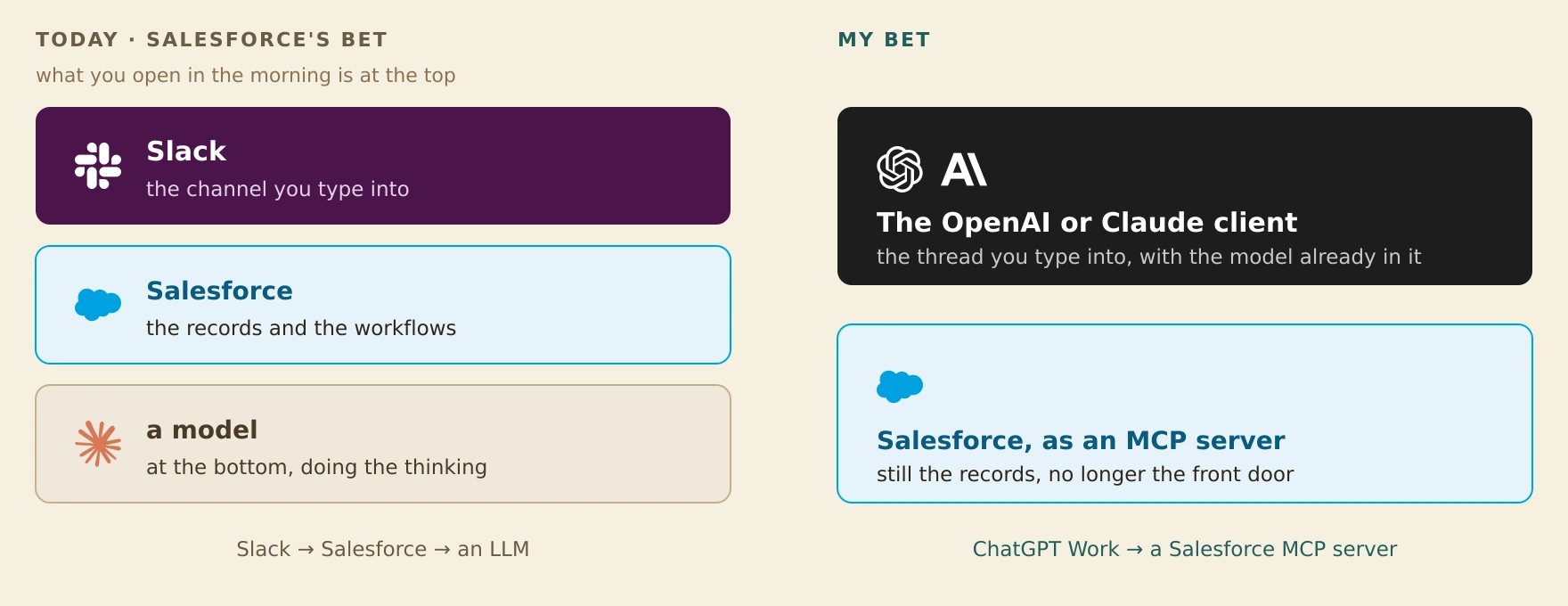
Salesforce isn’t waiting around to be replaced. In March it shipped thirty AI features into Slackbot and started calling Slack “your agentic OS”. Benioff was asked whether Salesforce’s web UI would fade and said “there’s no question”, and that they’re rebuilding the whole interface on Slack. This week’s Claudeforce press release has the line “the UI is the AI”. That’s roughly how I think software goes too: data and rules underneath, a model in the middle, and an interface generated for whatever you asked for instead of a fixed set of screens. Where we differ is the container. Salesforce says the container is Slack. I say it’s the OpenAI or Claude client. Today the stack runs Slack, then Salesforce, then a model at the bottom doing the thinking. I think it inverts: ChatGPT Work at the top, and Salesforce underneath it as an MCP server. Same components, and the one you open in the morning changes.
For now, Anthropic has picked Salesforce’s side. Claude is the default model in Slack and it powers Slackbot. Claude Tag, launched in June, is a single Claude per channel that everyone can see and steer, and since August it reads the whole channel and decides whether to reply, start a thread, route it, or say nothing. Anthropic calls Slack its preferred multiplayer platform internally, and Salesforce owns a stake in Anthropic. So the “Anthropic replaces Slack” half of my original idea is dead, for now. Anthropic is inside Slack, and whatever Slackbot has become, it’s Claude doing it.
Nobody is buying Slack
I started this thinking an acquisition was on the table. It probably isn’t. OpenAI does buy companies, and the pattern is interfaces and tooling: Sky, the natural-language Mac interface, folded into ChatGPT; Statsig, whose CEO became CTO of Applications. None of those are Slack-sized, though after this year’s funding round the money isn’t the obstacle. The obstacle is that Slack is the front door of Salesforce’s entire AI strategy. There is no motivated seller. Microsoft holds about a quarter of OpenAI, and Teams is bigger than Slack, protected by Outlook, identity, SharePoint and Windows being in the same bundle more than by being good. So when I say ChatGPT replaces Slack, I mean the slice Slack actually owns: startups, tech companies, the people who’d move first.
AI that comes to you
Slack has had AI features for a while now. As a standard user I haven’t seen any of them. Slackbot got thirty new capabilities in March and I have never once run into one. Do I have to go and find them? That’s been the shape of AI for a long time. It sits there and you go to it. Open the tab, type the question, wait, close the tab.
Viktor is the opposite, and it’s the first thing I’ve used that is. It’s an “AI employee” from a startup that raised $75 million in May with Slack’s cofounders as angels, and it came into our work Slack, introduced itself, and told us what it had read and what it could do. It joins threads when it thinks it can help. It prods me by DM when it wants to do something. It turned one sentence from me into a Linear ticket with the owner, the due date and the caveat I’d mentioned all in the right place, and I didn’t go to it once. For a long time I’ve wanted AI to come to me instead of the other way round, and this is the first time it has. That’s what AI is meant to be: a participant, not a destination.
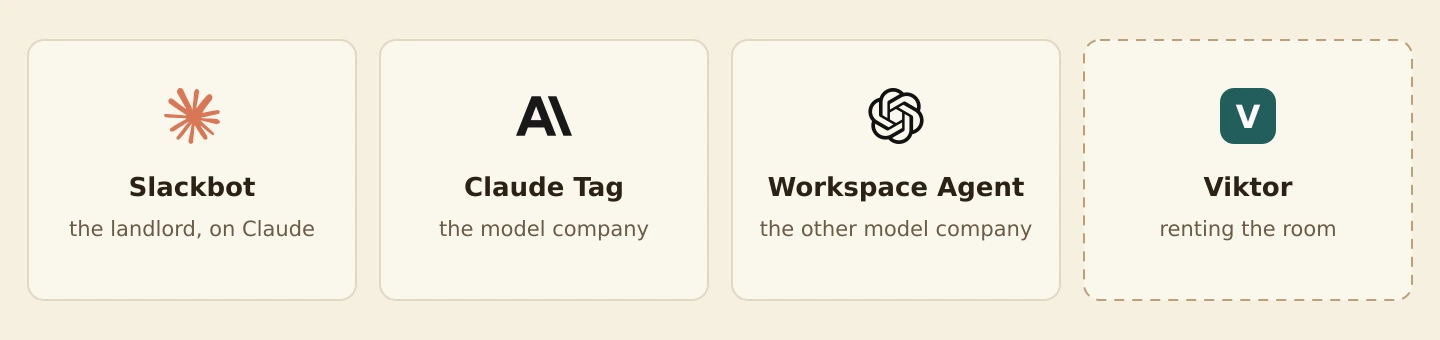
Viktor’s moat is being in the channel. So is Slackbot’s, and Claude Tag’s, and OpenAI’s Workspace Agents’. Viktor is renting the room from all three, and OpenAI only needs to own enough of conversation, memory and company search that the extra employee stops being worth a seat. I don’t see a bright future for Viktor on its own. Its way out is being bought for the team, and it’s good enough that I’d expect one of the three to do it.
What it means for Jira, Linear and the rest
I don’t know yet. The ticket tracker is the next tool along. I was at a meetup recently and got talking to someone who works for a competitor to Jira. They’d just put AI summaries into the product. I couldn’t see the point. If ChatGPT or Claude can read the same tickets through a connector, and both already can, ChatGPT’s summary is going to be better than the one the tracker ships. Not because the tracker’s team is bad. Because OpenAI has its best engineers building a harness generic enough that the model works out what belongs in a summary on its own, and they rebuild it every few months. The tracker has a prompt someone wrote in a sprint. If your moat is that prompt, or your judgment about what goes into the context window and what stays out, that’s a weak stand. Those are the two things the labs are best at.
Linear and Jira won’t vanish overnight. Teams still need one place that holds the record, who’s assigned, what state a ticket is in, what shipped, and Viktor filed that ticket into Linear, not into a chat. But the reading, the triage and the collaboration move into the conversation, and the tracker becomes the database underneath. So what is the product at that point? A designed schema, some governance around it, and an MCP server in front so an agent can read and write efficiently. That’s a real thing to sell. It’s a much smaller thing than what they sell today.
I’m not sure they keep even that. ChatGPT Sites launched on 9 July, the same day as Work: you describe an app in chat, OpenAI builds it and hosts it at a URL, and the pitch is explicitly the internal tools people actually need, dashboards and project trackers and small workflow apps. Anthropic has been pushing Artifacts the same way for a while, and Claude points me at one more often than it used to. They can call the model and connect to MCP servers now. Both companies are sitting on enormous amounts of compute and working out what to sell next, and I think a good part of the answer is hosting: the running cost of the small apps we ask them to build. That’s an Odoo-type move waiting to happen, where one thing you already pay for quietly turns into twenty business apps.
Then the ask stops being “summarise my tickets”. It becomes “set me up a ticket tracking system for our sales team, look at what we’ve already got in Salesforce, read our company notes in Notion, and build it”. We are not far off that. What comes back won’t be Jira. It’ll be closer to a basic Trello that already knows your data, and for a lot of teams that’s the end of the conversation. It’s going to be a rough few years for everyone whose product is a screen on top of the team’s data.
What I expect to see
Three levels, in order of how sure I am.
| How sure | What happens |
|---|---|
| Almost certain | Shared Work tasks and team workspaces in ChatGPT Business, where more than one person can watch and steer an agent run. |
| My bet | Several humans and several agents in one persistent ChatGPT thread, within twelve months. |
| The consequence | Teams start using those threads instead of some of their Slack channels, and by August 2027 the line between chatting with your team and prompting your system has almost gone for the tech-forward ones. |
Once that happens, the question stops being whether ChatGPT can compete with Slack and becomes why the place I talk to my AI isn’t also the place I talk to my team. Salesforce is betting Slack becomes the interface to AI. I’m betting the AI becomes the interface to everything, including the other people on the team. I could be early. I don’t think I’m wrong.
If I push it further out, the question in my head is about the device rather than the app. In 10 or 20 years we will replace our phones with something in our eyes. Not glasses, a contact lens of some sort. And the question I’ve always come back to is who owns that operating system. Microsoft, Apple, Google, maybe even OpenAI. I still quietly root for Anthropic, and I don’t know why.