The player who asked to rename their island solved my virality problem
This dev log is about Inselnova: one island, sea wars and alliance politics in a world that never resets. Play free →
TL;DR: I had three ideas for getting players to invite friends. All three were wrong. A player’s throwaway question gave me the right one. The insight: people don’t share games, they share things they’ve made their own. Stop trying to reward the invite. Gate the personalisation.
Three ideas I didn’t use
I spent a while on the virality problem. Inselnova grows by word of mouth, and word of mouth needs a hook.
My first idea was coins. Invite a friend, get free currency. This is how most games do it. I hated it immediately. Nobody wants to tell a friend about a game because they get coins. The friend feels like a conversion, not a person.
My second idea was troop gates. Restrict a unit or a building behind a referral. The problem is obvious once you think about the player. You’ve been building your island, enjoying the game, and now you hit a wall that says “bring someone else or you can’t have this.” You haven’t done anything wrong. The game is just holding something hostage.
My third idea was spy gates. Restrict espionage behind invites. Same problem. Spying is a core part of how the game works. Restricting it creates two tiers of player: people who recruit well and people who play worse. A bad player shouldn’t have worse tools.
None of these felt right because they all start from the same assumption: players need to be bribed or pressured into sharing. That assumption is wrong. Or at least it’s the wrong place to start.
What Rory Sutherland changed
I went down a rabbit hole on Rory Sutherland. If you haven’t come across him, he’s a behavioural economist and a good one to argue with when you’re trying to figure out why players do what they do.
His point on personalisation stuck with me. People want to make things their own. When they do, they feel ownership. Ownership creates attachment. Attachment keeps people around longer than any loyalty mechanic you could build.
That sounds abstract, but the practical version is simple. Give someone a plain mug and they’ll use it. Let them put their name on it and they’ll feel weird throwing it away. The mug hasn’t changed. The feeling around it has.
The question for Inselnova became: what can a player make their own? And, more usefully, what do they want to make their own that I haven’t let them yet?
The question a player kept asking
Multiple players asked if they could rename their island.
It’s a small thing. Your island starts with a generated name. You didn’t choose it. It’s yours in the game sense, but not really yours in the “I want this on my profile” sense. Players wanted to fix that.
I’d had island renaming on the list for a while. But I deliberately waited. I wanted to know what players actually cared about before I handed things out for free. The rename request coming in from more than one person was the data I needed. They want to claim it. They want to stamp their name on the place.
That changed the question from “what do I reward them for inviting someone?” to “what do they want to personalise, and how do I let them earn that?”
The answer was there in the request. You invite someone to the game, you earn honours, honours let you rename your island. The gate isn’t a wall. It’s a trade. You help the community grow, you get to make your corner of the map more yours.
How honours clicked
I’d had an honours system sitting around for a while with no natural home. It was one of those ideas that made sense in principle but didn’t connect to anything in a way that felt earned.
The rename mechanic gave it a purpose. Inviting earns honours. Honours unlock personalisation. The flow made sense to players because the reward matched what they actually wanted, not what I thought they should want.
That’s the part I’d been missing. I’d been thinking about virality as a numbers problem. Get the conversion rate up, design the incentive, ship the feature. But players don’t respond to optimised incentives as well as they respond to things that let them express something.
Name your island something that means something to you. That matters more than fifty coins.
Flags are the same idea at alliance level
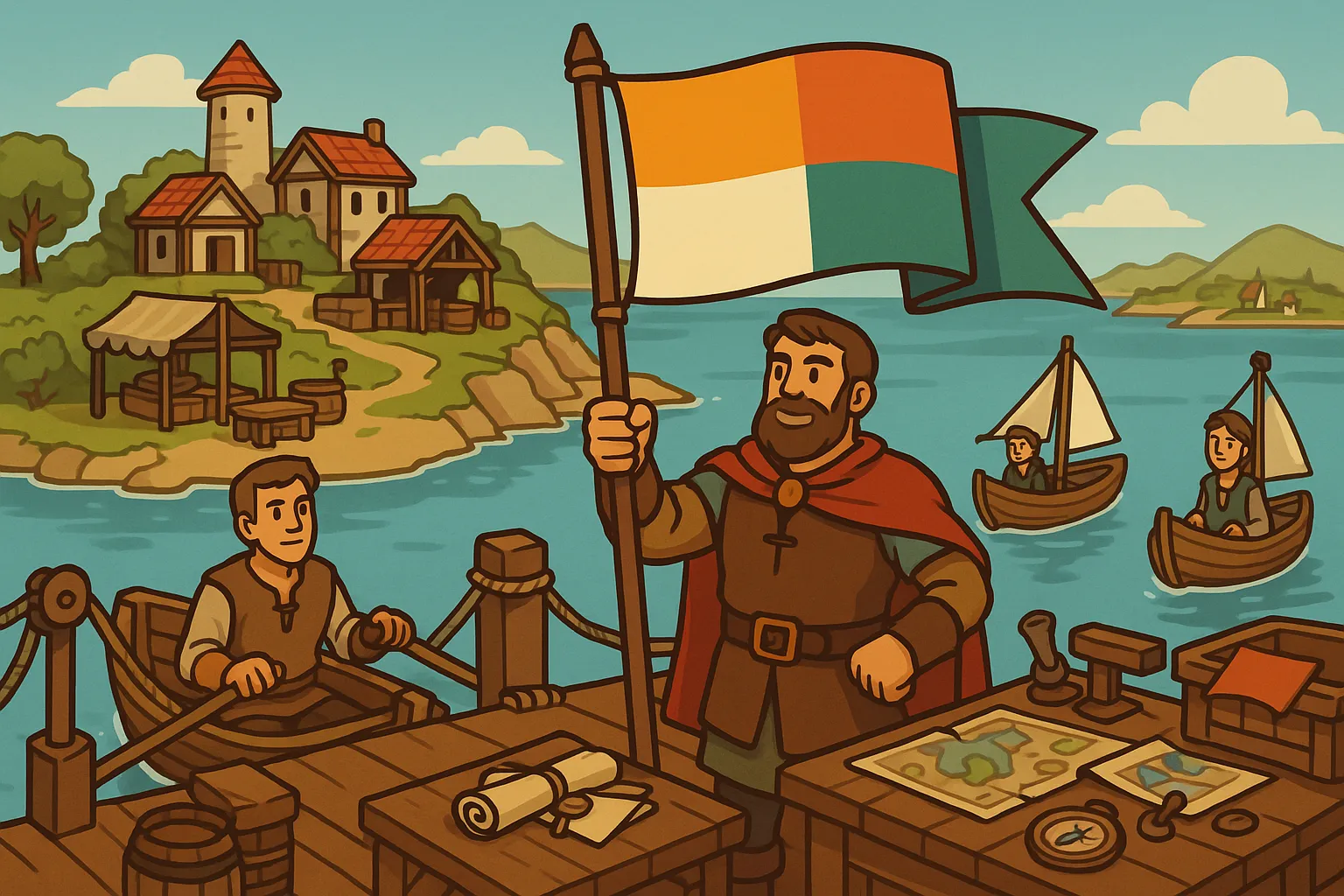
I’ve been building alliance flags. The original game had three-letter tags for alliances. We removed those early on because they felt like labels, not identity. A badge that says “NOR” tells you nothing about whether this alliance is worth fearing or joining.
Flags are different. You design one. It goes on the map, on the alliance page, on raid reports. When your alliance hits a target, your flag is part of what happened. That’s yours in a way a tag never is.
The Rory Sutherland point applies here too. An alliance with a flag they designed behaves differently to one with a generated abbreviation. They have something to defend. They have something to show off. New members are joining something with a visual identity, not just a name.
I didn’t build flags because I thought it would improve retention metrics. I built it because players want to make their alliance theirs, and I hadn’t given them a way to do it. The metrics will probably follow. They usually do when you give players something they actually wanted.
What I got wrong and what I got right
What I got wrong: thinking about virality as a mechanical problem to solve. Coins, gates, referral codes. That framing treats the player as a conversion to optimise rather than a person with things they want.
What I got right: waiting. Multiple players asked to rename their island before I did anything. That’s the signal worth waiting for. They told me what they valued. I just had to make them earn it.
The pattern is the same for flags. I didn’t build flags on a roadmap. I built them because I kept hearing players talk about alliance identity. Wait for the thing players say they want. Then put a gate in front of it that makes sense.
Gate identity. Not gameplay.