Every wave of new players tests the game the last wave helped me fix
This dev log is about Inselnova: one island, sea wars and alliance politics in a world that never resets. Play free →
TL;DR: Every time I push the game somewhere new, a wave of players arrives and a handful of them get vocal fast. They message me in-game, add me on Discord, find the bugs, name the confusions, and hand me ideas I hadn’t thought of. Around mid-game they drift off, usually near each other because they arrived together and some of them are friends. Then the next push brings the next batch. I pulled six months of data on this and the pattern is clear: the number of people talking to me each week has never hit zero, the names just rotate. Each fresh batch stress-tests the first few weeks of the game with new eyes, and plays the improvements the previous batch asked for but never stayed to see.
A few players get loud fast
Every time the game picks up new players, a few of them turn into regulars almost straight away. Not quiet regulars. The kind who tell me exactly what they think. They check the in-game messages, they add me on Discord, they report the thing that broke, they tell me the part that made no sense, and then they start sending ideas. Not “your game is broken” ideas. “Here’s how this system would be better” ideas.
They stay nice the whole time, which sounds like a small thing until you’re the one person on the other end of every message. These players carried the game through months of rough edges and stayed friendly while they did it. Then they hit mid-game, drift a bit, and move on. That doesn’t worry me. The game’s still in development, I’m playtesting it in the open, and I’m honest with the players who reach out that it’s unfinished and that I’ve never made a game before. Them easing off around mid-game isn’t something going wrong, it’s just where the built-out part of the game currently ends.
The waves, and how long they stayed
Here’s the clearest way to see it. Every vocal player I’ve had, twenty-one of them, drawn from the day they joined to the day I last saw them, coloured by the wave they arrived on.
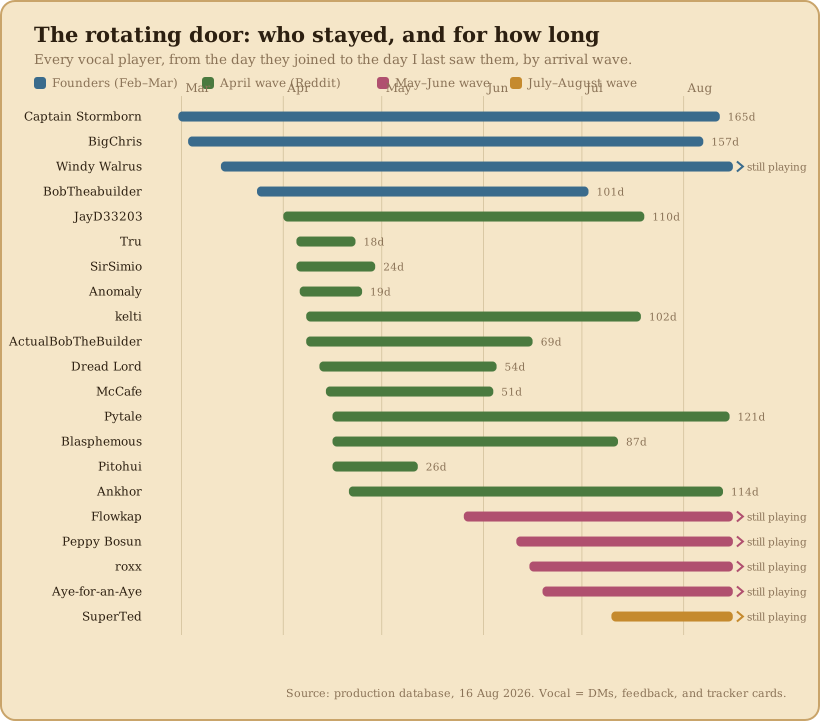
One group fades as the next begins, and across the whole six months there hasn’t been a week where nobody messaged me. Three waves stand out, and each one lands just after I pushed the game somewhere. April was a Reddit post that brought 322 new players in a single week. The May-June and July-August waves are smaller, but the shape repeats: a rush of new voices, a slow fade as they work through the game, then a fresh rush of people I’ve not spoken to before.
The idea machine
The bug reports matter more than you’d think. The game is deep and tangled enough that I can’t hit every path myself, so I need people finding the breakages. But a report is often just the start. It turns into a conversation, and the conversation turns up something bigger than a bug: a rule I set that doesn’t hold up in some case I never thought about, a decision that works for one kind of player and fails another.
One player, Pytale, opened 52 tracker cards over about four months. Keep the scroll position when you switch islands on the build tab. Let me scrap ships, because four idle merchant ships keep delaying everything on my capital. Don’t wipe every island a player owns when the Black Tide takes their capital, it’s a flat way to lose. Rebalance the Divine Strain blessing, the wait is too harsh for what you get. Filter dispatches so the important ones don’t get buried. That’s not a bug list. That’s someone playing the game harder than I do and telling me where it bends.
He’s the busiest, not the only one. In April alone, 19 different players sent 87 pieces of feedback between them. JayD33203 sent 12 ideas and bug reports over 110 days. BobTheabuilder sent 9 over 101 days, along with 25 messages. The most useful players aren’t the ones who report a crash. They’re the ones who want the game to be better and can tell you exactly how.
A lot of this also happened in the game’s chat and on Discord, which I haven’t fully tallied, so the exact counts are close rather than precise.
They arrive together, and they move on together
The clustering is real, not a story I told myself afterwards. The vocal players sort into the same signup weeks. Six of them started in the week of the 6th of April. Three more, roxx and Aye-for-an-Aye among them, started together in the week of the 15th of June. They come in on the same wave, which means they’re reacting to the same version of the game, and they end up playing near each other from day one. Some know each other before they arrive.
Which also means they wind down together. When Dread Lord stepped back in early June because the competition had thinned out, Pytale mentioned it to me directly, unprompted. They weren’t strangers sharing a server. They were a small group that arrived on one wave, and the group eased off together around the same stretch of mid-game.
Every wave is fresh eyes on the first few weeks
Here’s why the rotation is useful rather than just survivable. A player who’s been in the game for three months can’t see the first week anymore. They know where everything is, they’ve internalised the weird bits, and their feedback shifts to late-game balance. Valuable, but it’s a different job. The players who can tell me the tutorial-stage confusions are, by definition, the ones who just walked in.
So each wave hands me a clean read on the opening of the game, from people who owe it nothing. The April batch found the confusions of February’s game. The June batch walked into a game April had already improved, and found the next layer. The August batch is doing it now.
And there’s a second job each wave does without knowing it. The previous batch left me a pile of improvements they asked for but never stayed to see. The next batch plays them cold. They don’t know an idea came from a player called Pytale or Dread Lord, they just hit that part of the game and either sail through or get stuck. That’s the cleanest test an improvement can get: judged by someone with no memory of the problem it fixed.
The shape, in plain numbers
Most of a wave never becomes anything, and the flattering version of this would be a lie. The 322 players from that April week were mostly one session and gone. The vocal regulars are a small slice off the top of each wave, maybe a dozen people who go from a signup to someone I’m talking to most days.
Most of that dozen stay one to three months. Anomaly messaged me 66 times in 19 days, a whole relationship at fast-forward. Blasphemous stayed 87 days and sent 79 messages. A few never rotate out at all. Captain Stormborn and BigChris have both been here around 160 days, and Windy Walrus has been active for 156 and counting. Under the churn there’s a small permanent layer, and on top of it the door turns.
By late May, Flowkap had arrived and sent me 239 messages, the most of anyone. In June, roxx started and sent 125. In July, SuperTed. Different people, same role, each batch picking up roughly where the last one left off.
What I do with this
Two things fall out of the data. Mid-game is where the vocal players consistently ease off, so that’s where the biggest open design work is, and I’d rather learn that from a repeating pattern than a guess. And the front of the funnel works: six months, three pushes, three waves, and every wave produced people who helped me build the game. I’m not trying to stop the door turning. I’d rather spend the time between waves making the game better, so each new batch walks into something the last batch would barely recognise.