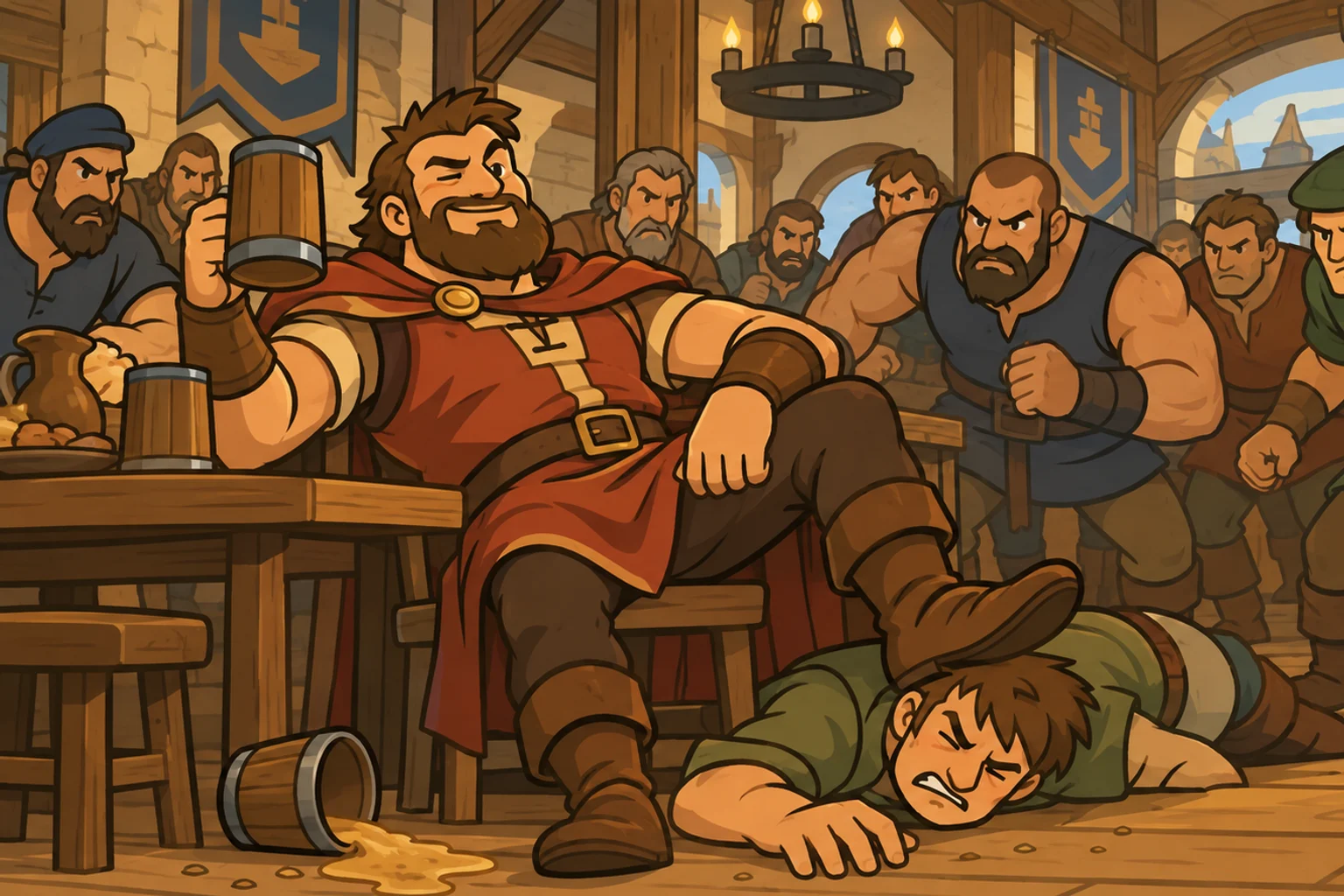
Player agency in Inselnova: you can attack anyone, and it will cost you
This dev log is about Inselnova: one island, sea wars and alliance politics in a world that never resets. Play free →
TL;DR: I want Inselnova to be a game where you can attack anyone you like and the game never tells you no. What it does is put a price on the choice and show you that price before you send. Hitting a much smaller player who’s still playing costs you ships, loot, your anonymity and your Honour, and if you keep doing it a WANTED poster goes up with a bounty on it. The old browser strategy games mostly did this job with blocks: beginner protection, points ratios, OGame’s bashing rule. Giving players agency and then giving that agency consequences is harder to build, and the game isn’t all the way there yet.
What I want Inselnova to be
- You can attack anyone. The game doesn’t say “you can’t”.
- Every choice has a price, and you see it before you send. No hidden multipliers.
- Picking on smaller players who are still playing costs the most. More of your ships lost, less loot, your name on it, and your Honour.
- Abandoned islands are fair game. Picking over an island somebody walked away from is part of the fun, and it keeps the map from filling up with dead realms.
- A few hard lines protect people who haven’t chosen a fight. Your first seven days, your capital, your last island, and a realm you’ve shuttered while you’re away.
- The world does the policing. If somebody keeps preying on the weak, other players get paid to go after them. It shouldn’t take me and my own fleet.
- It isn’t there yet. The first version is in the game, the numbers are a first guess, and I expect to be tuning it for months.
How it works in the game now
When you send any fleet, the game works out whether it’s a punch-down, an even fight or a punch-up. It saves that answer with the attack, and every rule reads the same one. The send screen tells you which it is, why, and what it’ll cost you before you press the button.
- A punch-down on a player who logged in within the last fourteen days brings home less loot and loses more of its own ships and troops. It gets worse each time you go back to the same player.
- An anonymous assault on a much smaller active player isn’t anonymous any more. Plunder stays anonymous, but it still counts against you.
- Every player has an Honour. Everyone else sees a label: Renowned, Respected, Unremarked, Notorious or Wanted. Only you see the number, and the attack screen shows exactly how much an attack will change it.
- Raiding, piracy, fair fights, abandoned and Blighted islands and the Black Tide never cost Honour. Punching up, beating off the Black Tide and claiming a bounty earn it.
- Good deeds don’t buy off bad ones. They’re counted separately, and only time brings the bad count down, or somebody bringing you to account.
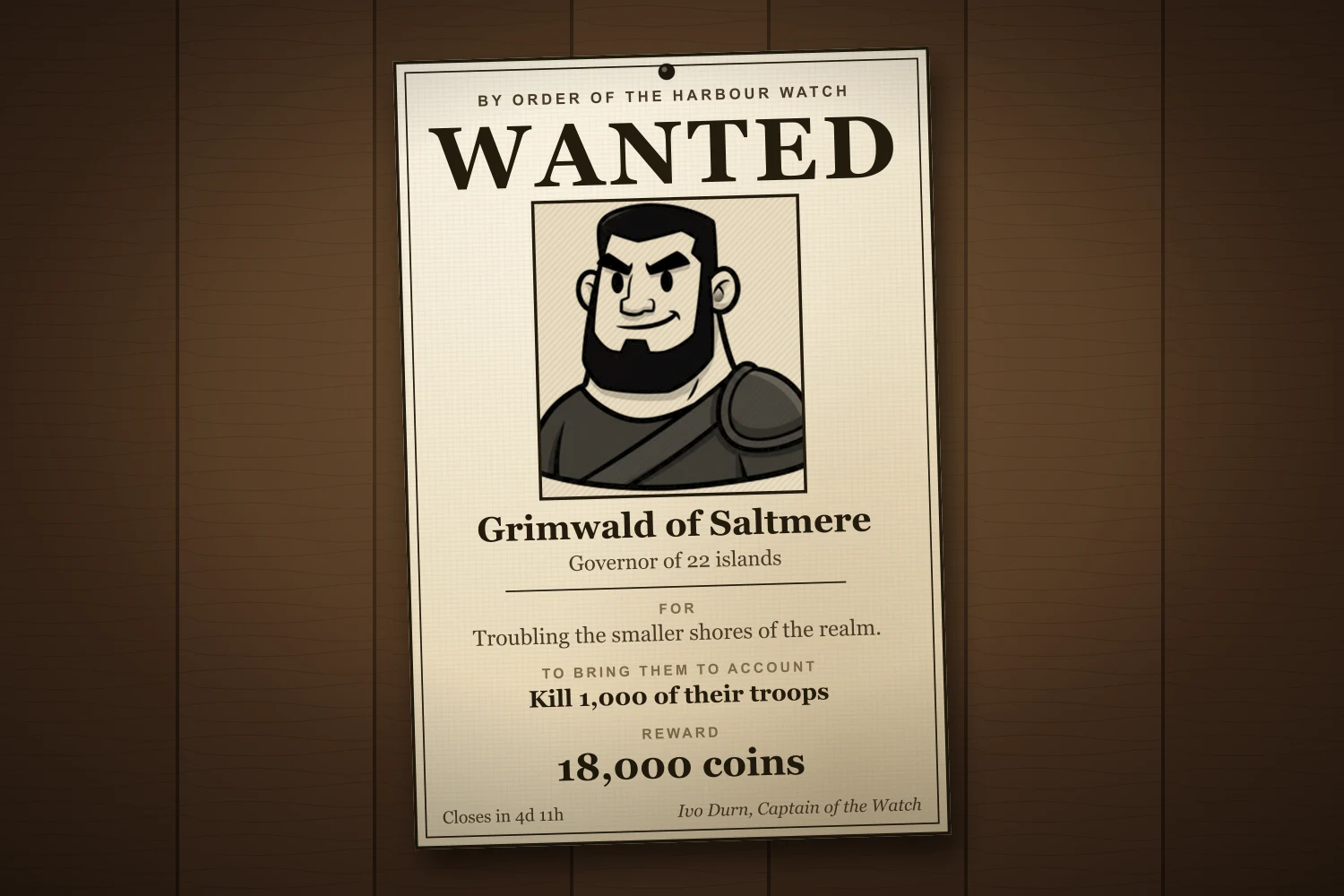
- Cross the line and you’re Wanted. A poster goes up with your avatar, your name, an 18,000 coin reward paid by the game, and a job for whoever wants it: kill 1,000 of your troops, plunder 10,000 goods from you, or win three battles against your islands.
The poster shows on the Tavern’s Leads board, on a page in front of the next day’s Chronicle, and on your profile. It lasts about six days, and there are never more than five in a world at once. It doesn’t say who you hit or how often, only one vague line about troubling the smaller shores of the realm.
A price has to cover every attack
On 24 August a new player asked me whether they’d get flattened by the big realms. I told them: “The big players are safe, they’re all friendly. And there is a punch down mechanic so it’s not worth them to attack down.” A month later one of the biggest realms in the world emptied the capital of a player who’d been in the game for nine days. Two anonymous assaults landed seventy seconds apart. The first killed the garrison. The second was 10,000 small warships with empty holds, which sailed into an undefended island and left with 154,502 stone.
The player’s alliance leader, Wilhelm1908, messaged me that morning: “This is the kind of thing that will kill a game dead in its tracks if huge players can do this without restraint.” They were right, and the fault was mine. The punch-down rules existed, but I’d only ever wired them into plunder runs. An ordinary assault went through the combat code without asking how big either side was. I refunded everything the two waves took.
The numbers showed the same gap. In the two weeks around that attack, plunder runs against players five or more times smaller took 9,309 resources in total. Assaults across the same gap took 16.8 million. Plenty of that came off abandoned islands, but the big hauls on smaller players were all coming through the mission my rule didn’t touch. Nobody argued with the plunder rule. They just used assaults instead.
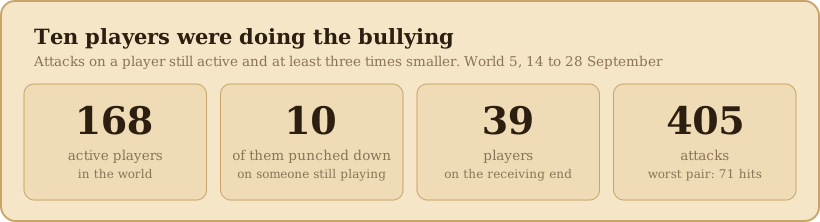
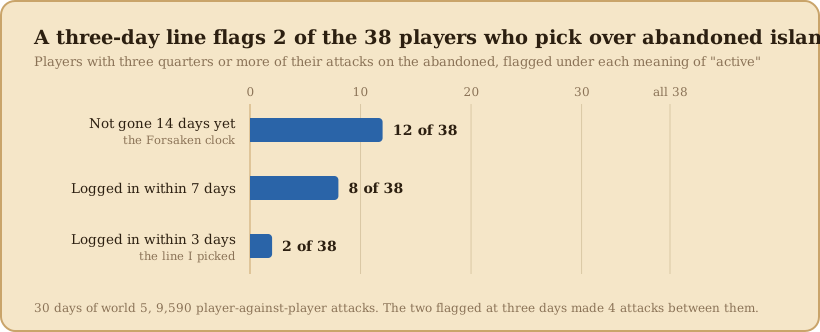
It’s also a small group. Of 168 active players, ten attacked someone still active and at least three times smaller. Between them they made 405 attacks on 39 players, and nine of the ten hit the same victim three times or more. The hard part was catching those ten without catching the players who pick over abandoned islands. If “active” meant “not gone for fourteen days yet”, twelve of the 38 players who mostly hit the abandoned would have been flagged. With “logged in within the last three days” it’s two. So I started with three days. On 9 October, five days after Honour went live, I moved it to fourteen and made a winning punch-down assault lose ships as well, so a Governor who’s been away for up to two weeks keeps the protection. That flags more of the players who mostly hit abandoned islands, twelve of the 38 by September’s numbers, which is the trade I’d turned down three weeks earlier.
Colonisation: take it away, make it hard, then help
Colonisation is where I worked this out, and I’ve tweaked it more than anything else in the game. In early March it was a flat roll, so the biggest realms could keep taking islands as fast as the smallest. I made the odds drop the more islands you held, then tightened it a few more times: 65% to start, eight points off for every island you already have, a 5% floor, and from five islands up a failed charter can sink your colony ship. The send screen shows all of it.
Then I gave players something to help. The workshop makes Supply Chests, and each one packed on a charter adds 5% to the odds. When they first went in you could pack six, which lifted a large empire’s 5% floor to 35% and let one 56-island realm take something like 25 to 30 islands a day. Two days later the limit was two. So it went: I took something away, made it possible again but hard, and then handed back something to help with it. You can still take a thirtieth island. It costs a lot more than your fifth.
The times I did put up a wall, it didn’t last. In May I made islands only takeable from players who’d been gone for fourteen days, and two months later I took it back out, because nothing could happen to anyone who logged in. In August I deleted a warning on the attack screen because players were reading it as a ban.
Players had an honour code, and I enforced it with my own fleet
None of this is a new idea to the people playing. On 16 April, BigChris declared a bounty on another player in world chat, and I opened a card called “Honor score” the next day. Alliances wrote their own rules about who was fair game, and I counted at least nine players who’d put some version of one in writing.
"Anyone who hasn't logged in for 3 days I consider fair game for raiding."
I’ve enforced that code myself. In April a player came back from a break and attacked someone who hadn’t logged in for ten days but was still in an alliance. I sent fleets straight back at them. “Just returned to the game, and immediately attacked by admin,” they wrote. I told them they should have asked first, and called off the rest of my attacks. A few weeks later they came back to find everything they’d built destroyed and told me the game was bullshit. I don’t know how much of that was me, but the admin turning up with a fleet isn’t a system.
One player filed a feedback card the day after the September attack. They’d just killed the troops of someone who’d been away for six days and then come back, and they felt bad about it. “I trust your decision,” they wrote, “and hope for more protecting mechanism instead of just relaying on players sense of fairness.” A code that only the nice players follow doesn’t protect anyone from the rest.
How OGame, Travian and Tribal Wars handled farming
Every old browser strategy game had to answer this, and most of them answered it with a block.
| Game | What it does | Blocks or prices |
|---|---|---|
| OGame | Newbie protection by points ratio (1:5, then 1:10), and the bashing rule: no more than 6 attacks on an active player’s planet in 24 hours | Blocks |
| OGame | Honour points (2011): attacking much weaker players costs honour, and Bandits lose 100% of their loot when raided instead of 50% | Prices |
| Travian | Beginner’s protection, 5 days on a normal server plus a one-off 3-day extension. Its morale bonus for small defenders was removed in 2022 | Blocks |
| Tribal Wars | Morale: attack a much smaller player and your troops fight at as little as 25% strength | Prices |
| Grepolis | Morale again, with a 30% floor that rises as the defender owns more cities | Prices |
| Ikariam | New-player protection. The bashing rule is no longer enforced | Blocks, then nothing |
| Inselkampf (still running today) | 30 days’ beginner protection, and you can’t attack anyone under half your points | Blocks |
Beginner protection is the one everyone had, and the complaint about it is always the same: it delays the farming and then it ends. A Travian player wrote in 2009, “The second my BP was over I was raided every 30 minutes.” Bashing rules only worked when someone reported a breach, and when Ikariam stopped enforcing theirs, a forum admin’s answer to a new player being bullied was “anyone can attack anyone.”
Morale is the closest thing to what I wanted, and OGame’s honour points from 2011 are the nearest ancestor of the whole idea. Both got gamed. Grepolis’s developers wrote in 2017 that players had found “clever use” of morale’s flaws, because it reads points and points can be managed. OGame’s players said honour encouraged bashing defences instead of raiding for profit. I read all of it as a list of ways this can go wrong.
What could go wrong
Every game that’s tried player bounties has hit the same problem. In Ultima Online, murderers got a friend to make a clean character, kill them, claim the bounty and split it. EVE Online had bounties collected by the target’s own second account for nine years before it changed the payout. So hunters here can’t be in your alliance or your contacts, can’t have traded or shipped with you lately, and can claim on the same player once a month. Two friends could still fake it. I’ve accepted that, because the job still costs the Wanted player a thousand real troops or ten thousand real goods, and I watch the claims myself.
Ultima Online is also the one I think about most. After three years of trying to price murder with titles, bounties and red names, they made a copy of the world where you couldn’t attack other players at all, and the playerbase doubled. Most of the people playing Inselnova are in their forties and want something they can check a few times a day without worrying who’s coming for them. Some of them want a proper war. I don’t know yet whether one set of rules can hold both.
I’d still rather find out by pricing things than by walling them off. A price I can turn up or down each week, and a wall is either there or it isn’t. The Black Tide is on its seventh version and I don’t expect this to be right the first time either.