Eight months in: balancing, onboarding and the next big step for my browser strategy game
 by Darren, who builds Inselnova
This dev log is about Inselnova: one island, sea wars and alliance politics in a world that never resets. Play free →
TL;DR: Eight months in, more people play Inselnova in a week than at any point since April. The week of 19 October had 185 players, and 74 of them had played before, the most returning players the game has ever had. Most new players now find it through Google rather than through my posts. The weak point is the front door. About 13% of new players come back the next day, down from about a quarter in May, and I haven’t solved it. Balancing is a list of 54 open tickets, which I think I can fix, and loose ends, which I enjoy. I also tried to build an end game and stopped after a month. What I’ve done since is make the game that’s already there easier to read.

Who’s playing
The lowest point was the week of 1 June, when 33 people played. I’d stopped posting, the April crowd had mostly gone, and I wrote about the mid-game going quiet. Since then the weekly number has climbed in steps: 102 at the end of August, 154 in late September, and 185 in the week of 19 October.
The number I care about more is the returning players. In April, about 50 people a week were back from an earlier week. Through June and July it was 22 to 36. In the week of 19 October it was 74. 58 players have now played on 30 or more different days, and 12 on 90 or more. On a typical day about 65 people play.
They also grow the way I hoped. A player in their first week has one island. Between a week and a month in, the median is two. Past a month it’s eight. That’s the shape the game is built around: you start with one island, then you have three or four, and then you’re looking after a realm.
Where the new players come from
The chart is every new player since the end of February, by week, split by where they first came from. I wrote about the first half of this in September, so I’ll keep it short.
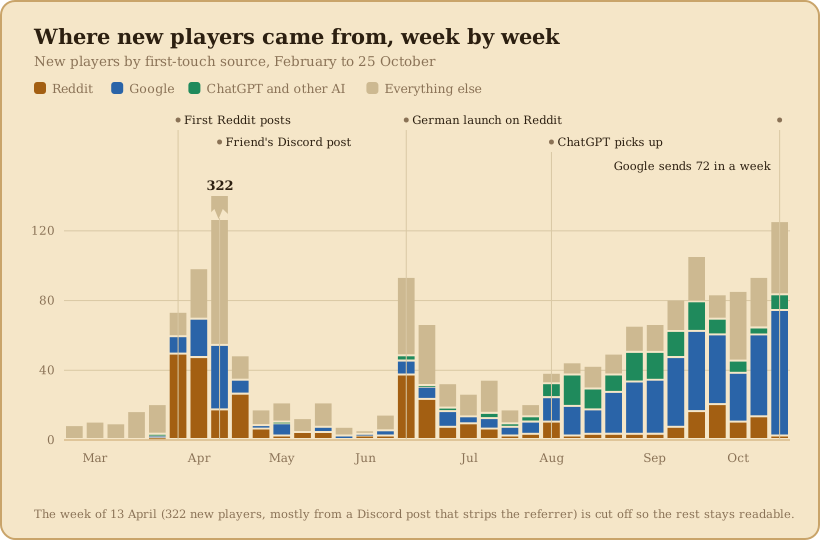
Until August, the spikes are posts. The biggest week was 13 April, when a friend posted about the game on Discord and 322 people turned up. From August the bars stop spiking and start climbing, and that’s mostly Google. In the week of 19 October, Google sent 72 of 125 new players. October has had 353 new players so far, against 546 in April and 67 in May.
Reddit is quiet because I’m quiet on Reddit. I’m not posting there while I work on the onboarding, only replying under other people’s posts. ChatGPT, which sends nearly all of the AI traffic, peaked earlier than I expected. It sent 18 new players in the week of 10 August and 4 in the week of 12 October, and I don’t know why it fell.
Most of October’s new players are guests. Guest play went in around 8 June, and 251 of October’s 353 are still on guest accounts. That makes the numbers bigger and the average newcomer less committed, which brings me to the part I’m least happy about.
Onboarding, and the thing I haven’t solved
The onboarding check I run asks one question: did a new player finish the tutorial and play for at least 20 minutes on their first day? Passing is by far the best predictor I have of whether someone comes back. In the week of 12 to 18 October, 12 of the 17 players who passed came back within eight days, against 3 of the 76 who didn’t. Only 18% passed that week, the first week below the 22 to 34% range of the four before it. The next-day return that week was 13%.
I’ve rebuilt this a lot. By June there were five versions, from no tutorial at all in February to guest access. Version 6 went in on 3 July and rebuilt the plumbing underneath. Version 7 went in on 24 August and bookended the tutorial with a first stone and a charter. Since then three smaller rounds have shipped, with new screens, more help along the way and a schedule for a new player’s first day. Depending on how you count it’s seven or eight versions, and the small ones made a bigger difference than their size suggests.
None of that has pushed the numbers up. Next-day return was about a quarter in May and it’s about 13% now. Part of that is who arrives: guests and search traffic are less committed than people who read a long post about the game and chose to try it. But I’ve also changed the tutorial and the traffic at the same time, so I can’t separate the two.
The tutorial today is step by step, with big buttons and a lot of text. That’s deliberate. The game started as something for people who like spreadsheets, and I want a wider crowd to be able to play it. My worry is that I’ve made it too simple for the original crowd. Someone who’s played this kind of game for years sees a lot of hand-holding and leaves. I don’t know if that’s true. What the data shows is where players stop: the gold mine step went from losing 4% of the players who reached it to 17% over three weeks, which is a lead but not yet a finding, and training the first stone thrower loses 12 to 16% every week.
One idea I want to try is a question at the start: have you played this kind of game before? If you have, you’d get a shorter way in. It’s only an idea at the moment, and it needs more work before I build it. There’s already a button to skip the tutorial, but skipping isn’t the same as a way in that fits someone who knows the genre.
I can’t work on onboarding all the time. It’s the most tiring part of the game for me, because every change is a guess and the result takes a week to read. So I look at it about once a month and work on something else the rest of the time.
The end game I stopped building
In March I wrote “Don’t plan the endgame.” In July I did it anyway. The plan was to start at the end: build a second world you’d choose to sail into, then work backwards to see what the middle was missing, because players kept asking where the end game was. I spent about a month dipping in and out of it, and it kind of works. But it was flat. It had some different dynamics and a few interesting ideas, and I got to the point where I didn’t even want to play it myself. It also would have opened another can of worms: a second set of rules, a lot more support issues and a lot more questions, on top of the ones the main game already has.
So the second world is on hold. Looking back, jumping to the end game with the game in its current state was a mistake. There’s a lot of balancing to do and a lot more depth to add to what’s already there, and I’d rather sort out the questions and support issues on the main game first. I’ve come to think more players is a feature in its own right: a busier world does more for the game than a second one would. I’ll come back to it.
Some of its ideas came across to the main game instead, and the Ruptures are the first of them. A Rupture opens, a Kindled creature comes through, and players can attack it. They shipped on 24 September and there have been two Ruptures so far. In the first, on 10 October, one player made all 20 strikes and killed all four creatures. The second closed after about 20 minutes with nothing struck. So far exactly one player has fought one, which tells me they’re too rare and too hard to notice. They could be fun, but that needs work.
The doctrines came a bit later, in September. There are four, Wealth, Attack, Defence and Stealth, and each one groups blessings and curses. I modelled them on the four gods as a starting guess, and they’ve held up better than I expected. Players asked for the usual thing, where you pick a faction when you join, and I didn’t want that. It locks you in, and the only way to try another is to start a new account. So the doctrine belongs to an island, not to you. An island gets one when it has a steward, and 187 islands have one now. Wealth is by far the most popular, 70% of them, and 10 players already run more than one doctrine across their realm.
Depth, by making what’s there easier to read
Most of my time since has gone into depth, and I’ve come to think depth doesn’t mean more systems. It means you can read what’s happening, see why, and trust the numbers. The clearest example is attacks. When you attack someone, the game gives you a good forecast before you send anything. When someone attacks you, you get a red line in the ticker and whatever your watchtower can see, and nothing about what’s likely to happen. The fix is a defence view that shows each incoming fleet and how the fight is likely to go: an exact forecast at sea and a range on land. The designs were agreed at the end of October and the work has started.
Smaller things like that have been shipping steadily. In the last six weeks: a replay of each battle, a statistics screen for your island, hovering over an island to see who owns it, and the Black Tide saying why it came for you. None of them is a feature anyone would put on a store page, but together they’re most of what makes the game feel deeper than it did in the summer.
Balancing and loose ends
There are 54 open tickets on the tracker with a balance label, and 28 done. The biggest groups are the economy (14), combat and units (12), and raiding and punching down, where a big player hits a much smaller one (9). About 23 of them came from players, through messages or Discord, and the rest are mine.
The pattern when something lands badly is the same each time: a player tells me, I decide what’s fair that week, and the fix ships three to ten days later. The Black Tide’s liberation payout went in on 5 September and was fixed on 14 September. A big player’s assault on a much smaller one on 23 September led to fixes between 4 and 9 October. The bounty pop-up went in on 6 October and was fixed on 9 October, and a fairness problem with bounties from 16 October is waiting to deploy now.
Bounty is close but not there yet. The game posts bounties rather than players, and since 6 October there have been 11, of which 4 were claimed and 5 expired, paying out 72,000 coins. The Black Tide makes 1,400 to 1,700 attacks a week on 24 to 36 players, mostly repelled. It has never taken an active player’s island. It has taken 114 islands from players who’d been away 30 days or more. It’s on its sixth version and I think it’s in a good place, apart from the balance tickets.
The loose ends are the enjoyable half. They’re things that were almost finished when I moved on, and finishing them is quick. Since the tracker started on 9 April I’ve shipped 1,653 tickets across 63 releases and 66 hotfixes. The last release, 0.113.0, had 22, and the one before had 92, 28 of them housekeeping.
Stewards are the piece I most want to grow. Today a steward is a seat on an island: appointing one gives the island a doctrine and lets you run bigger cargo routes. 187 are appointed, across 34 players. The aim is that stewards start running things for you, so you stop looking after one island, then three or four, and look after a realm. Very little of that is built yet.
I should also say this plainly. Everything I put in is a first version. I get something in, it’s probably the right thing, and it isn’t the final form. Players talk about it, sometimes they’re upset, and I change it as fast as I can. Then I learn from it. If something you play feels off, tell me.
A bigger screen, and a different-looking island
New players are mostly on desktop now: 71% in October, and it’s been over half every month since April. The regulars are more evenly split, and on my numbers slightly more of them play on a phone. I still like the game on a phone for five minutes with a coffee, and I’m keeping that. But most people arriving are on a wide screen, and the game doesn’t use it.
There are two pieces of work here. The first is a desktop layout: an optional setting that adds a column on each side of your island, and you choose what goes in them, such as building, your realm, messages or your inbox. On a phone nothing changes. That’s planned in detail and I haven’t started building it.
The second is a redesign of the islands. I loved The Settlers, and I want some of that feel in the game. I’ve built three prototypes. The first was a hand-textured 2D map, and it looked too rough. I couldn’t get the textures right, and it didn’t feel like Inselnova. The second was full 3D, and you could spin all the way around an island. It felt too fancy for this game, it dragged the frame rate down, and I didn’t want to spend my time fighting 3D problems on top of everything else.
The third is the compromise. Someone showed me a screenshot of another game’s map that I really liked, and it’s based on that. A lot of it is actually 3D, rendered once and baked into flat images, so it looks good without the cost of drawing 3D every frame. It runs at 60 frames a second in Chrome on my machine, and I can keep changing it without 3D getting in the way. I picked it at the end of October. You can zoom from the region view all the way into an island and right up close, people walk about and work, ships come and go, and smoke rises over the town. You tap a prepared plot and the building goes up. Later I’d like you to be able to lay paths wherever you want and decorate, but that isn’t built.
It’s eye candy, and it’s optional. A lot of players have asked for something like it, and I think it matters more than it sounds. Players who don’t care about it can ignore it and play the game as it is now, because it’ll sit behind a switch.
I don’t know yet whether the next big thing is an end game, the new map or something else. What I do know is that most players who get through the tutorial come back, and more people are reaching the front door every week. I’d rather fix the front door first.