Seven tavern mini games, and which ones players actually play
 by Darren, who builds Inselnova
This dev log is about Inselnova: one island, sea wars and alliance politics in a world that never resets. Play free →
TL;DR: There are seven mini games in the Inselnova tavern. Runs are short, and there’s nothing to win and nothing to lose. They exist for three reasons: they’re a break from building the main game, they’re a safe place to test smaller AI models like Claude Sonnet, and they give you something to do while the game’s timers run. Since July they’ve had 5,169 plays from 206 players in Founders World, the game’s main live world, and 71% of those plays are one game, Coin Stack, mostly on the screen you see when the bazaar has sold out. Some of the others have gone quiet, and a lot of players with a tavern have never opened its games.
Coin Stack came first, because of the bazaar
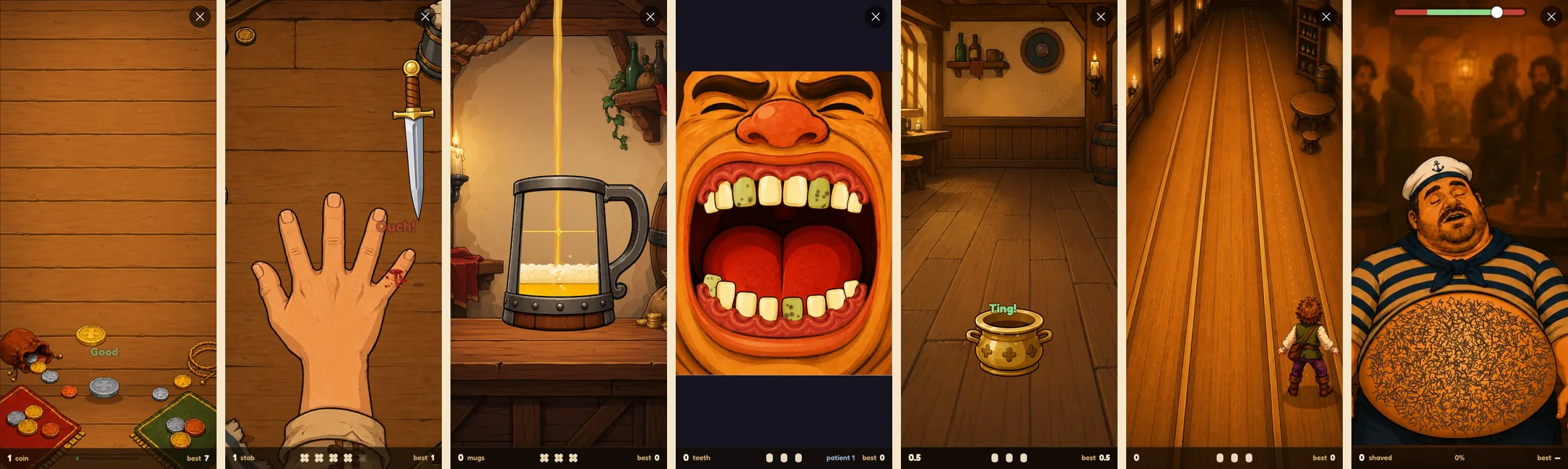
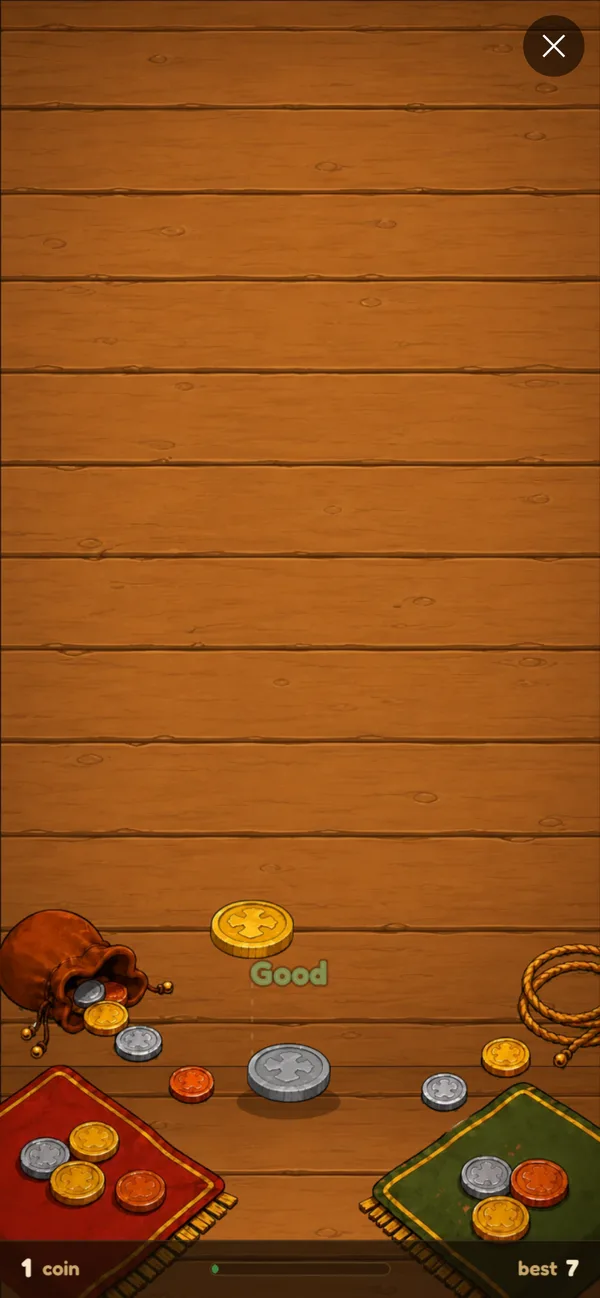
The bazaar, the in-game market, sells a few items at a time, and when they’re gone it sits empty until it refreshes. People sat on that empty screen waiting for the next refresh, and it struck me straight away that they should have something to do with their thumbs while they waited. So the first mini game was Coin Stack: a coin swings across the screen, you tap to drop it, and the stack grows until it wobbles over. It was built for the sold-out bazaar screen.
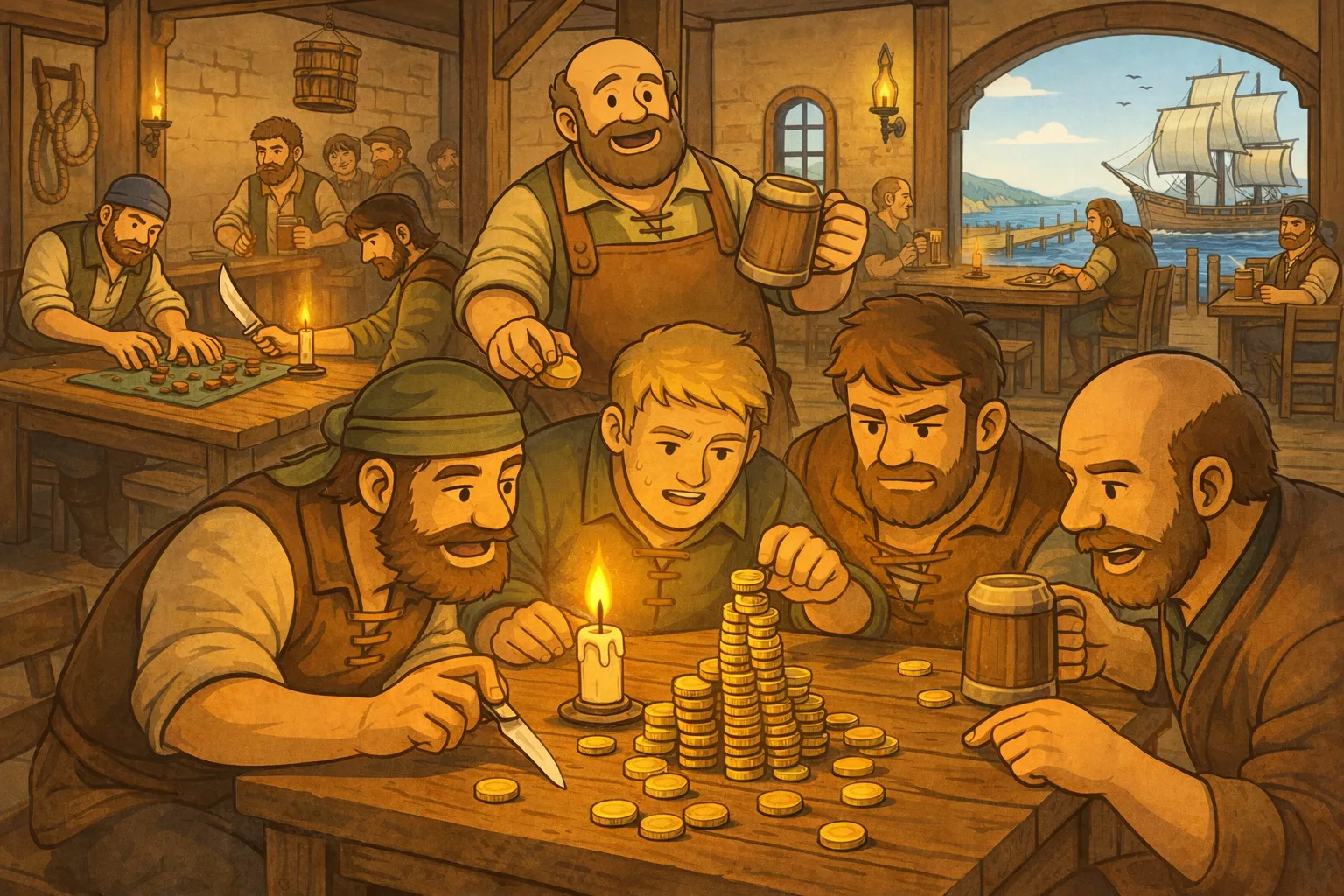
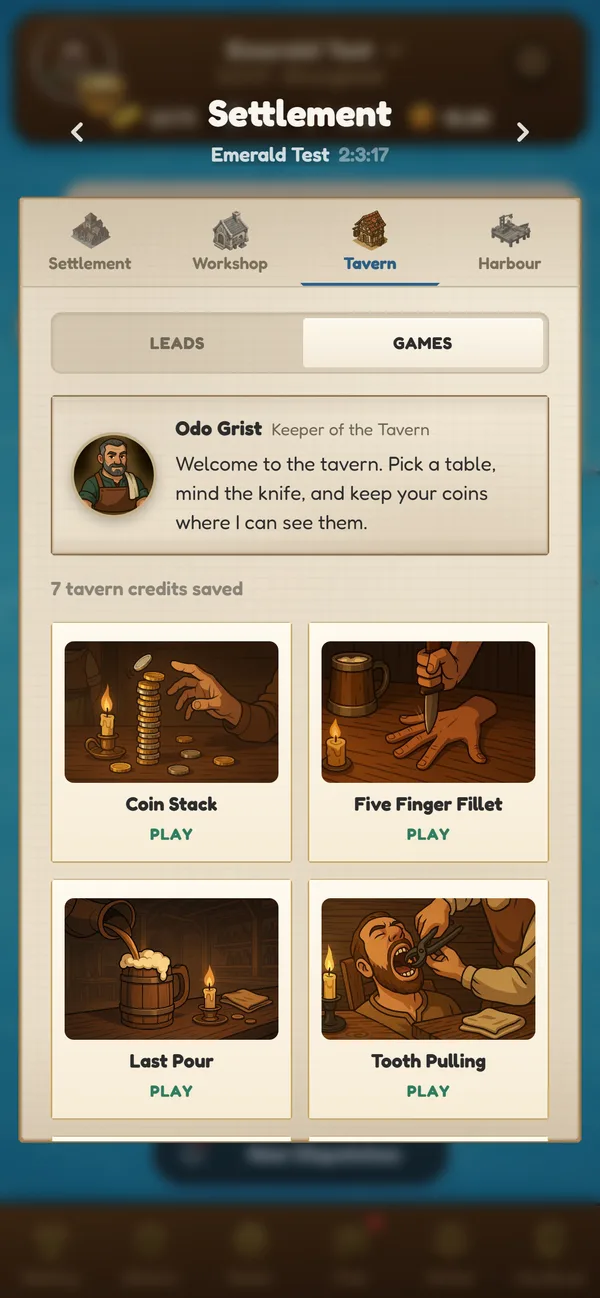
It was fun, so I built some more before it shipped. Players had been asking for a tavern for ages, and a tavern gave the games somewhere to live, so Coin Stack and the Tavern went out in the same release on 3 July, with Five Finger Fillet and Last Pour at the tables. Tooth Pulling, The Spitoon, Barrel Run and Shave the Belly followed on 10 July.
At launch each table was a one-time purchase with coins. I’d hoped that would work as a coin sink, but it was one payment per table, so it didn’t, and it gated the games too much. Now a tavern earns one credit per level and each table costs one credit, so the tables open up as the tavern grows.
Why a strategy game has mini games at all
The obvious reason is the timers. Inselnova is a strategy game you check a few times a day. You collect resources, you spend them, you run out, and then everything you’ve queued takes time. That’s the point of the genre, but it leaves gaps, and the mini games fill them. Loss has weight everywhere else in the game: your ships sink, your islands get raided, the Black Tide, the game’s hostile non-player faction, holds a grudge. In the tavern nothing is at stake, so you can lose a run and just go again.
The second reason is me. A mini game is a break from developing the game itself: a small, separate thing I can build and finish.
The third reason is that they’re where I test models. For the main game I use the big models, Claude Opus and Claude Fable, because they give good, predictable results, and the code they write has gone to production without bugs. I worry that a smaller model like Claude Sonnet would start introducing bugs into something players depend on. A mini game is safe ground for that. If it’s broken, it’s broken, and nobody loses an island.
What Sonnet did with a one-shot prompt
I built about half of the games with Sonnet. They’re simple games, so when I give it all the mechanics up front, it’s close to a one-shot prompt, and what comes back is about as good as Opus would have made. The big models build these very quickly too. What I found is that Sonnet is now good enough for this kind of job, and a mini game let me find that out without risking the real game.
The art goes through a different loop. Sometimes I start in ChatGPT, work on the concept until I like it, and get ChatGPT to draw the images. Then I bring them into the game and get Claude to cut them into the separate pieces the game uses. That works, but it’s choppy. These days there’s a script in the game repo that I already use for banners, buildings and research art. It calls OpenAI’s image model with a prompt plus example images, so the style stays consistent, and I can make all the art for a game without leaving the session.
The rules every game follows
- Simple. Nothing to learn before your first run.
- In the lore. It has to be something you’d find in a tavern. There will never be a fishing game, because nobody fishes in a tavern.
- Single player, for now. I want to build them and release them, and multiplayer would slow that down a lot.
- Fun and repeatable. A run is short, and losing one should make you want another.
- No ending. The games keep going until you fail. It’s all about the high score.
- It works with a fat thumb. Every game has to work on a phone.
- A bit strange to look at. The mechanic can be simple and done before, but I want it to look unusual if I can.
The tavern rule is restrictive, but the restriction helps me experiment. “If you walked into a tavern, what games would be there?” is a much better question than “give me a mini game”. When I ask OpenAI for ideas, it always comes back with catching rats and other boring, generic things.
Most of them are clones. Five Finger Fillet is the knife game. Barrel Run is a lane dodger. There’s no point downloading 20 different games when, eventually, I can give you 20 inside the game you’re already playing, ready to pick up. The work is in bringing the idea into the lore, getting the speed and the balance right, and making sure it feels good.
Making them gross
Making them look strange is where AI struggled most. I used OpenAI for Tooth Pulling, and it just didn’t want to make it gross. With Shave the Belly the model didn’t understand the idea at all. The mechanic isn’t original (shave the sleeping sailor only while his belly falls, and if you touch a hair on the way up he wakes), but the model had nothing to anchor the picture on, so it kept missing.
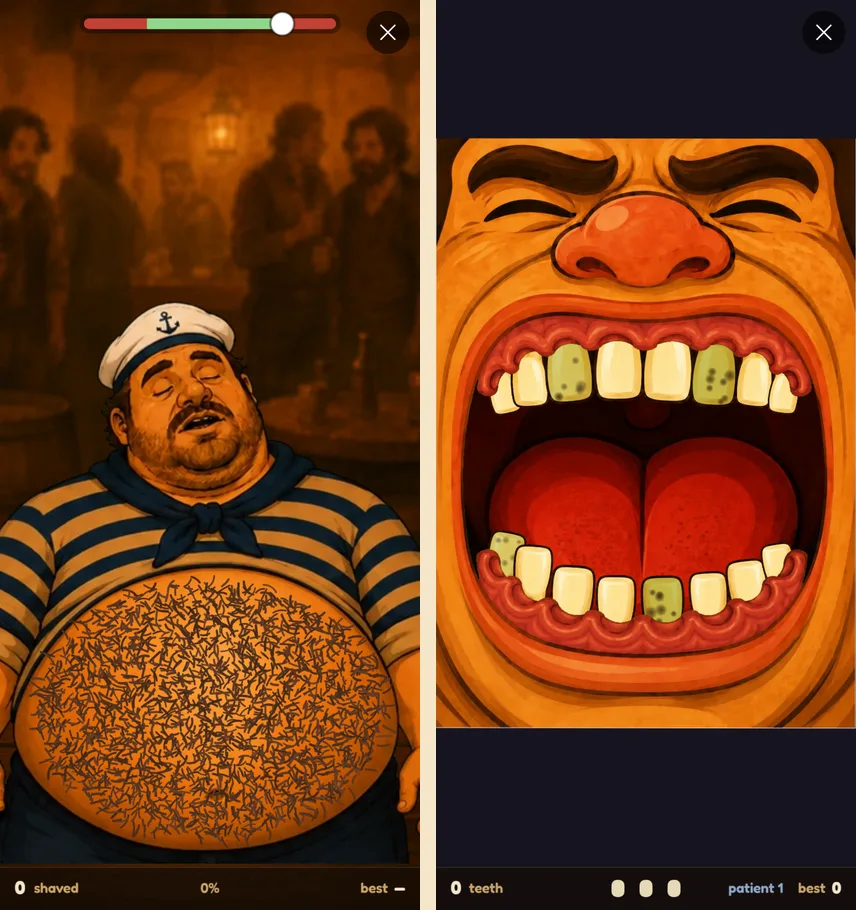
The models writing the games needed as much pushing as the ones drawing them, and I had to keep telling them: more gross, more rot, more hair, and for Five Finger Fillet, more blood. What usually works is getting a first cut, looking at it, and then asking how to make it more disgusting. Not every game is meant to be gross, though, and I have to be careful with that. The brief I give now is that some of them should be a bit interesting and a bit disgusting, not all of them.
The ones that didn’t ship
They’re quick to build, so I can find out quickly whether one is fun, and some aren’t. Crab Crack was one tap to crack a crab. I played it, and ten seconds later I thought, what’s the point, this is boring. The art could have been cleaned up, but the game underneath was the problem. Loose Nail and two versions of a tavern race never shipped either, and about six more I built in ChatGPT never left ChatGPT. A lot of what I mess around with in between doesn’t come out well, so I just drop it.
Which ones players actually play
The play log records finished runs: who played, which game, where, and the score. Since 3 July, Founders World has logged 5,169 runs from 206 players, counting guests and leaving out my own. Of the 201 players active in the last 14 days, 87 (43%) have played a mini game at some point.
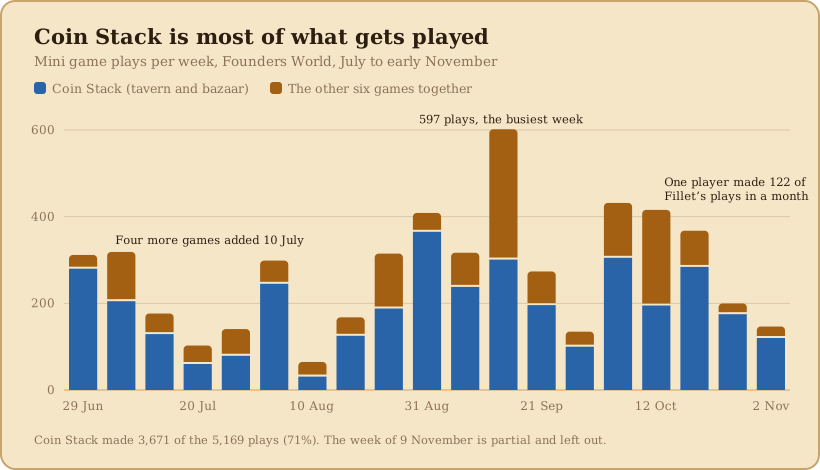
Coin Stack is most of it. It has 3,671 of the 5,169 runs, 201 players, and more than half of those players came back to it on another day. It’s also moved: in its first month, a quarter of Coin Stack runs were in the tavern, and in the last month it was 7%. Nearly all of its play now happens on the sold-out bazaar, where it started.
The other six get far less play. Every game has players, so none of them meets my bar for removal, which is literally nobody. But Tooth Pulling hasn’t been played since 19 October, and Five Finger Fillet, Last Pour and The Spitoon each had one player in the last two weeks. Fillet looks like it grew in the last month, but one player made 122 of its 213 runs in that time. I haven’t gone back to look at these properly yet. If one or two people like a game, I’d rather leave it up.
My guess was that a lot of players never find the other games. Coin Stack turns up on the bazaar whether you look for it or not, but the other six need a tavern, and then you have to open the settlement screen and go to the tavern’s games tab. To check, I looked only at players who are active now and came back after their first day, 97 of them. Of those, 86 have built a tavern, but 30 of the 86 have never unlocked a table. 53 of the 97 have played a game in the tavern, against 76 who’ve played Coin Stack on the bazaar.
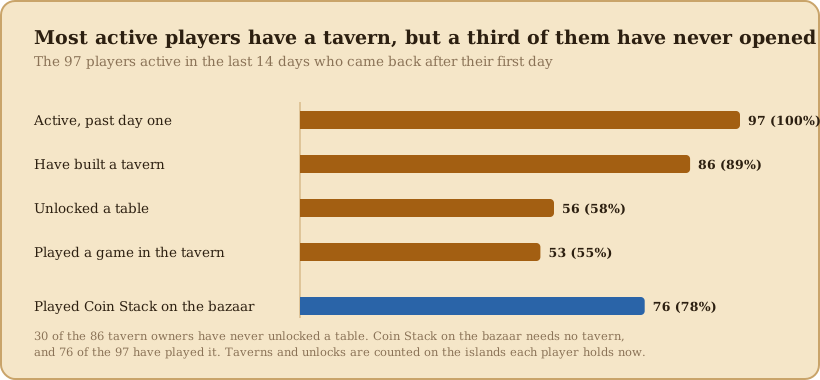
That fits my guess, but it doesn’t prove it. Some of those taverns may have been built for other reasons, and some players may have looked at the tables and decided not to bother, and the log can’t tell those apart. Building a tavern and finding the games are clearly two different steps, though.
My favourite is Shave the Belly. The weakest one, to me, is Barrel Run, where you move left and right between lanes. It’s a bit boring, and getting the lanes to work properly with the AI was harder than it should have been. I might still redevelop it.
The log doesn’t record how long a run takes, so time played isn’t something I can measure. These numbers also say what got played, not why. Coin Stack sits on a screen a lot of players visit, which probably explains more of its lead than the game itself does.
How your Coin Stack score compares

Every coin you drop scores a point, even a bad drop. A bad drop makes the stack wobble, and the fourth one brings it down, so the lowest possible score is 4. The median run is 11 coins, the median personal best is 23, and the best stack anyone has built is 79.
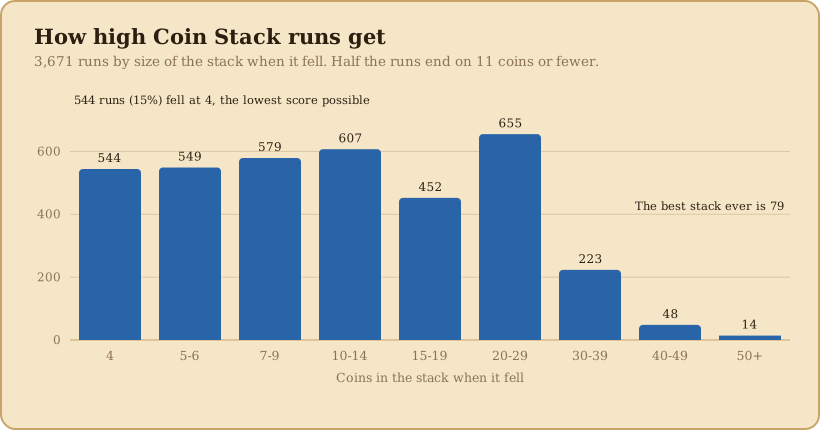
One run in seven ends on 4, the lowest score there is, and after the first few goes that barely changes with experience. Players with more than 100 runs still finish on 4 about one time in eight. I can’t tell from the log whether those are real misses or people giving up on a bad start and going again.
People play it in tiny bursts. In a typical sitting someone plays two runs, about 19 seconds apart. The typical player plays three or four runs on a day they play at all, and the busiest hours are 18:00 to 20:00 UTC. The exception is one player who did 70 runs in about an hour one evening in September.
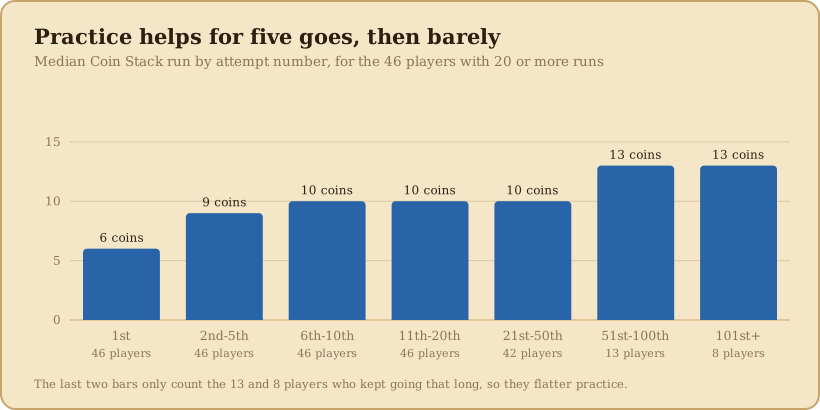
Practice helps, but not for long. Among the 46 players with 20 or more runs, the median goes from 6 coins on the first run to 10 by the sixth, and then it sits at 10 until run 50. The few who keep going past 50 reach a median of 13. Comparing each player’s first ten runs with their last ten, 30 of the 46 improved, and the typical gain was under two coins. Your first run doesn’t predict much either: people who scored 4 on their first go kept playing at least as much as people who scored 15 or more.
Some of you are not very good at it. One player has had 65 goes over nine days and has never got past 20. Another had 20 goes in a single day and topped out at 11. My own best is 29, which puts me 54th out of 202 players, counting me.
The best players at each table
Some of you are very good at this. These are the best scores in Founders World up to 11 November.
| Game | Best score | Held by |
|---|---|---|
| Coin Stack | 79 coins | Harried Heron, ahead of VoidPirate (73) and Tretger (66) |
| Five Finger Fillet | 33 stabs | VoidPirate |
| Last Pour | 40 mugs | ShurNL |
| Tooth Pulling | 209 | Flowkap |
| The Spitoon | 23 | ShurNL |
| Barrel Run | 2,483 dodges | Becks1428 |
ShurNL holds two tables. Becks1428 has also played more Coin Stack than anyone else, 354 runs. Shave the Belly isn’t in the table because its scoring is wrong at the moment, so its numbers don’t mean anything yet.
Where it goes next
The plan is about 20 games, almost all in the tavern, all single player for now. Players have asked for games against each other, and I’ve looked at a few multiplayer ideas, but I haven’t found one I like yet. There’s a folder of 42 written-up ideas to work through, and the ones that get built will be the ones that are quick to make, fun after ten seconds and, for some of them, a little bit disgusting.