AI coding is still waiting for its Rails
 by Darren, who builds Inselnova
This dev log is about Inselnova: one island, sea wars and alliance politics in a world that never resets. Play free →
TL;DR: I’ve been building software for over 30 years, and AI coding looks to me like web development before frameworks. Everyone is building their own way of working, and we’ve started calling it a harness. For the first year or more the community spent its time on tools, loops and tricks to keep the AI going, and a lot of that has been made unnecessary by the models themselves. My own harness works well for my projects now, and I expect something shared to replace it. I think we’re still early.
Everyone goes their own way first
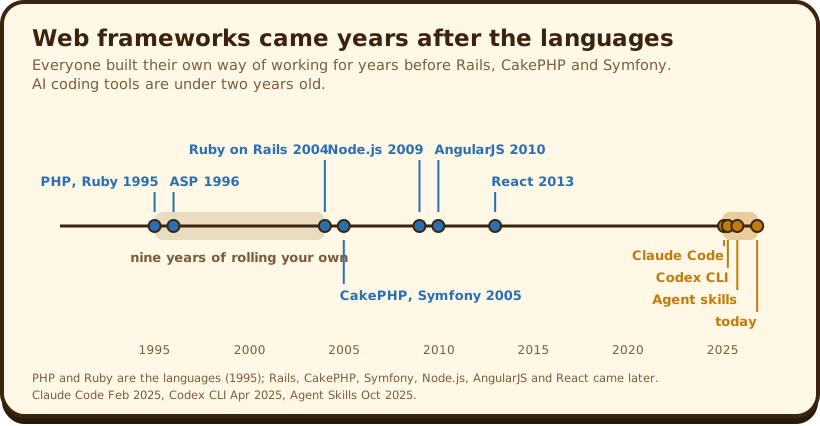
Before web frameworks, everyone went off in their own direction. PHP and ASP let you build a site, and every team then invented its own structure on top. Ruby came out in the same year as PHP, and it took until 2004 for Ruby on Rails to turn up on top of it. CakePHP and Symfony followed for PHP a year later, and people had something shared to build on. Node.js was a funny one, because no single framework took off there the way Rails did. On the front end, AngularJS arrived in 2010 and React in 2013.
I think AI coding is in those years now. Everyone is building their own framework, and we call it a harness. The word has shifted a little, but it’s the same activity: you build your own set of files, loops and habits around the model. Big companies are starting to publish their own, which is how it went last time.
The year of tricks
Before January this year, AI coding was poor for me. For over a year people had been building tools, loops and tricks to get the AI to keep working for longer, and for most of that time skills didn’t exist. A lot of YouTube videos showed how to set one of these up, and most of what I tried from them didn’t work for me.
There was also a tribe on each side, Codex on one and Claude Code on the other. It felt like Windows against Mac. I personally don’t care which one anyone prefers, and I don’t see why anyone else should either.
It felt like Windows against Mac. I personally don't care which one anyone prefers.
The agent setup I built and dropped
The one that everyone was talking about was persona agents. You tell one agent it’s a data engineer who knows how to look at data a certain way, and another that it’s a business analyst who’ll give you an executive summary. Then you have them pass work from one to the next. I tried it, and it was a lot of work for something that was complete rubbish. Maybe there was a glint of it being good, but AI is general purpose, and on the older models, even with a persona, it felt about half as good as what I get today.
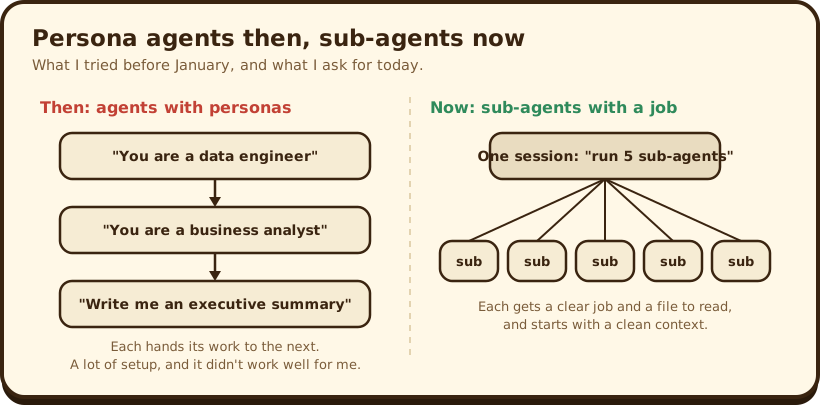
Now I tell it to run five sub-agents, give them a clear job like fact-checking something, and point them at a file so they know how to do it. That’s the whole setup. Sub-agents are useful because each one starts with a clean context, not because of a persona. I watched videos of complicated setups and thought: just wait three months. I’d had my own go at it, and a lot of the time it has been sorted in three months.
Just wait three months. It'll be sorted by then.
Why it got easier
Between January and March there was a run of new frontier model releases. For my work, two things I’d struggled with got good enough: getting the AI to write useful tests, and getting it to do decent design. I’m not saying testing or design is solved. I’m saying that what I need from them for Inselnova, I now get.
Why did it get better so quickly? I don’t know, but my guess is that it’s ordinary product development. The companies building frontier models, like OpenAI and Anthropic, all want to be number one, and they build their own products with their own tools. I think the sessions we run and the complaints we make show them where the model falls short. They’ve probably also used up most of the books and transcripts there are to train on, so the writing we type in every day is new material they want. If that’s right, listening to us is in their interest.
Where that leaves me
I have a workflow and a set of skills. When I start a new project, I tell the AI to look at the other project, copy the skills across and change them. The steps are roughly the same each time: brainstorm, spec, questions, design, build, shakedown, walkthrough, then live. It catches problems early, and it now helps with my other work as well.
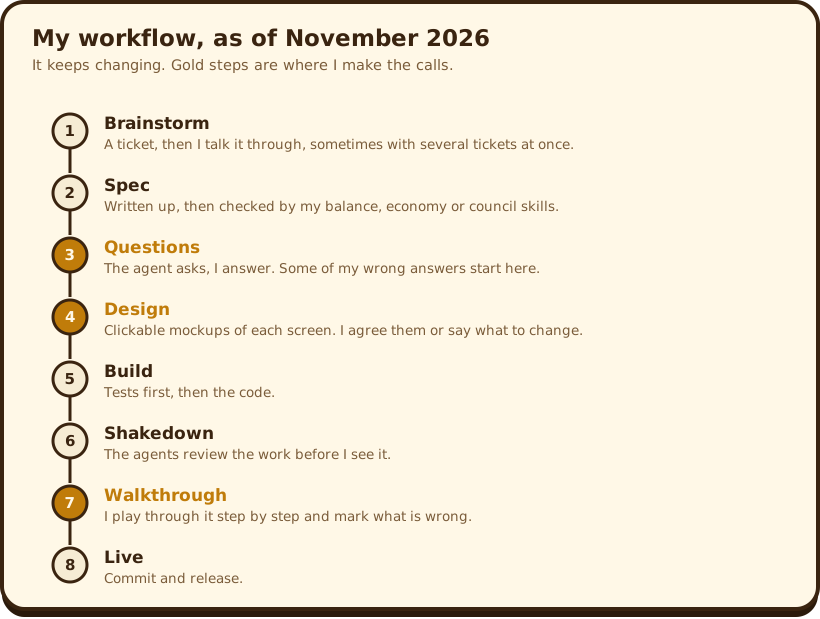
When it goes wrong, it’s usually because I answered a question wrongly or gave a bad instruction. That happens often, because I don’t always know what I want, so the walkthrough stage matters a lot to me. Most of the problems I remember started with my answers, not the model.
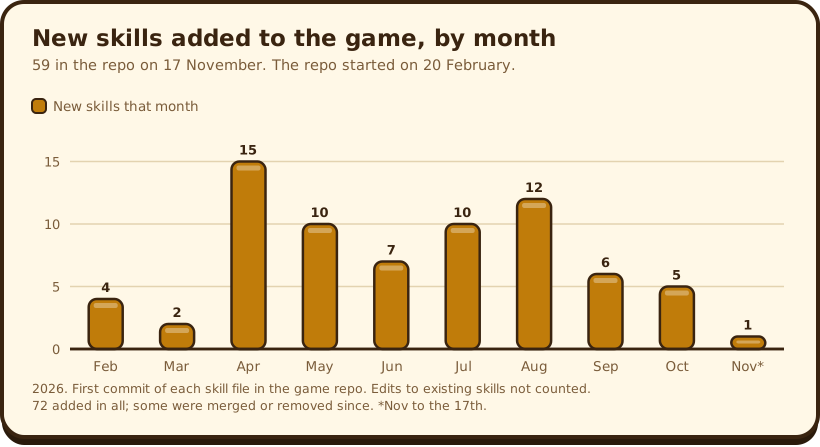
I’ll also say that the puzzle part, getting the AI to do what I wanted, was fun, and most of it has gone. For me that was around March, when my skills started doing what I needed and I was getting work out through the same workflow reliably, again and again. The game’s repo fits that: it started on 20 February, I added six skills in February and March together, then 15 in April. It isn’t perfect. It still writes big files and sometimes puts files in odd places, but programmers do that too. What’s left is routine: handing out instructions and checking what comes back, and that’s less fun than working out how to make it work.
What I expect next
We’re early. Everyone has their own harness, they all look a bit alike, and some of them are very good. The big companies are starting to put out their own: Google open-sourced the Elephant-Goldfish Model in October, where one long-running “elephant” session holds the design and fresh “goldfish” sub-agents with no memory of the conversation review it before any code is written. From the write-ups, it looks like the clean-context point about sub-agents turned into a method. I haven’t tried it yet, but the principle looks roughly the same as how I work. GitHub has Spec Kit, and there are probably another ten coming out every week from developers doing the same as me. It’s too early to say whether any of them becomes the Rails of this. Someone will build the version most people just use and stop arguing about, and my own harness will probably be replaced by it when it arrives.