Resources & Economy
The economy is not background noise. Gold sets the pace of orders, stone decides how hard the island is to crack, and lumber decides when the realm can reach the sea. A strong Governor does not simply gather more, they keep the right shortage from becoming the next crisis.
 Settlement & Life
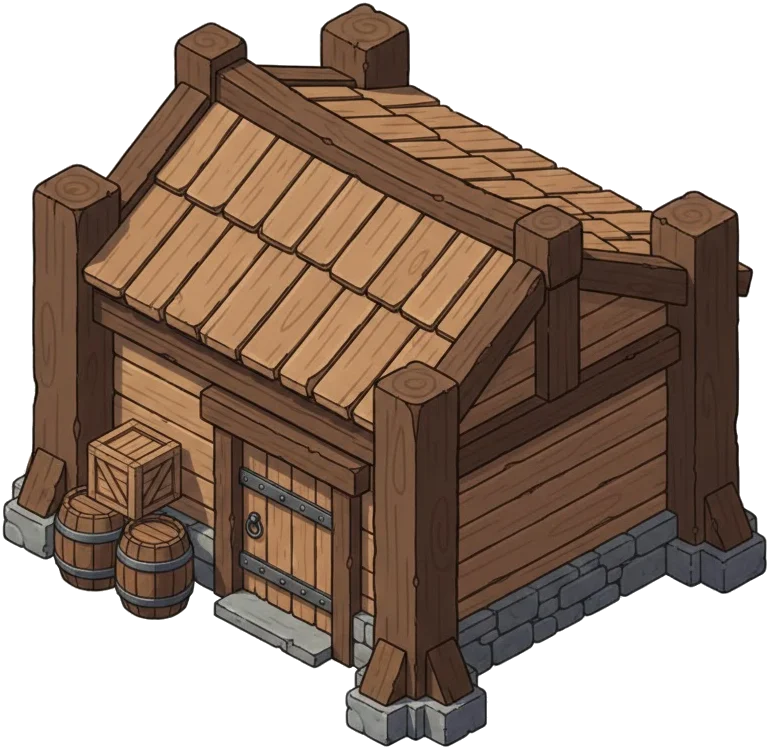 Buildings
 Bazaar
Opening Reserves
Every new Governor arrives with a provision chest: 250  Gold, 250
  Stone, and 250
  Lumber, plus 600 coins and 200 food. A Main House stands ready at level 1. The chest is enough to start the first mines, not enough to spend evenly on every tempting order.

The Three Materials
Gold is the flexible pressure: construction, research, troops, ships, and market decisions all ask for it.Stone is the defensive pressure: walls, infrastructure, and durable growth consume it steadily.Lumber is the naval pressure: ships, expansion, and late logistics punish any island that treated timber as a spare resource.
Each material has its own site: the 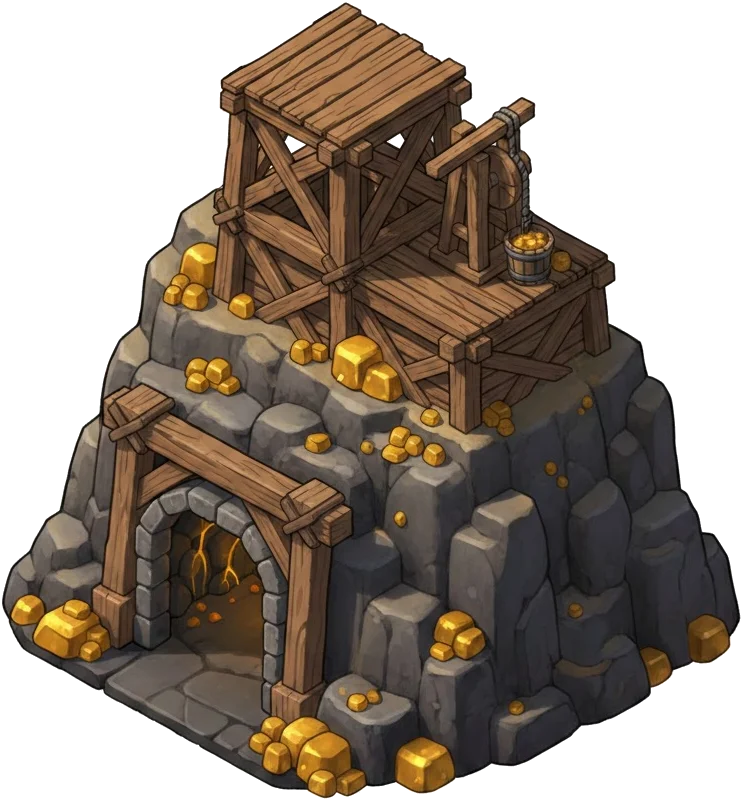 Gold Mine, the
 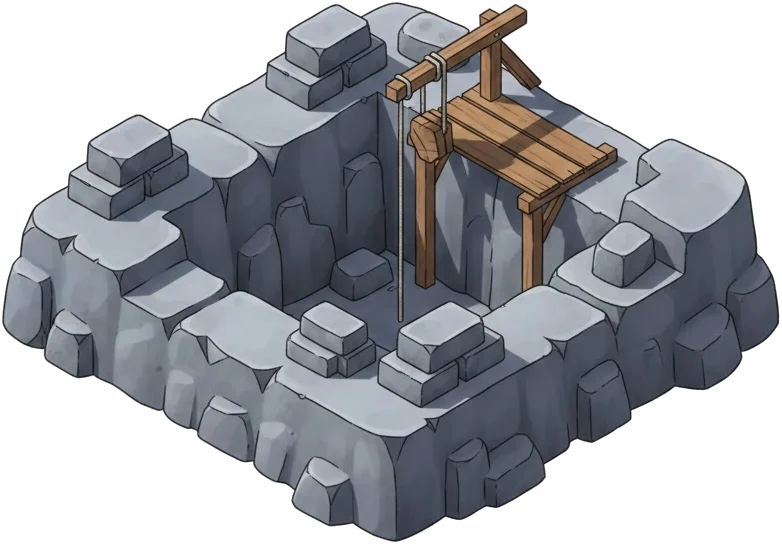 Stone Quarry, and the
 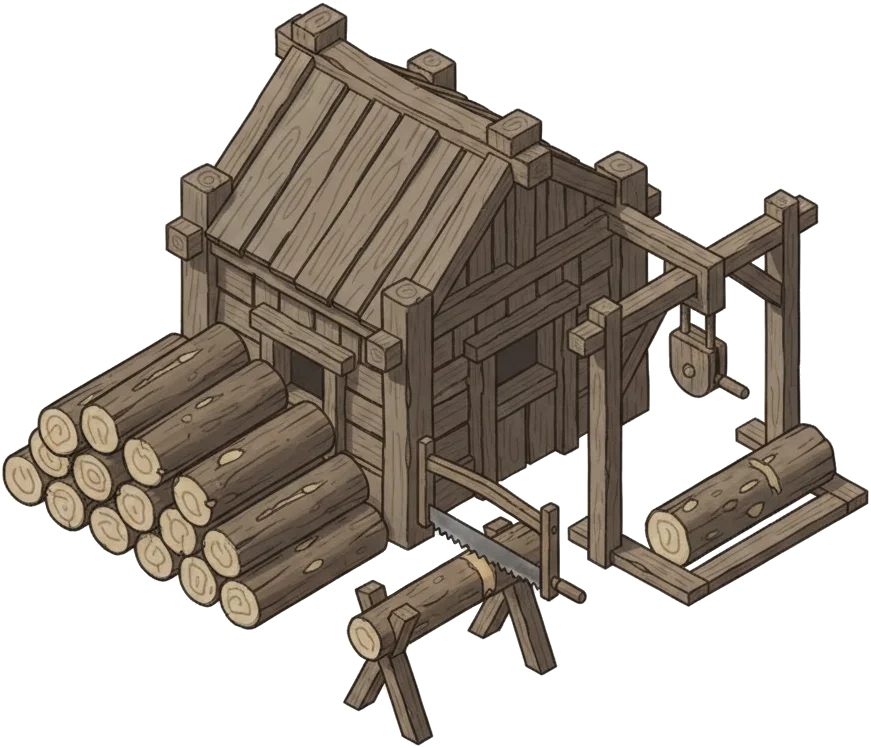 Lumber Mill. Even untouched land gives a small passive trickle, but mine levels are what turn a holding from a camp into an economy.
| Material | Early pressure | Later pressure |
|---|---|---|
| Gold | Orders compete for the same coin purse. | Research, ships, troops, and Bazaar timing. |
| Stone | Main House, Storehouse, walls, and civic works. | Fortified colonies and hard-to-raid islands. |
| Lumber | Mine balance and early construction. | Harbour, warships, merchants, and colony ships. |
Coin, Food, and Morale
Raw materials build the island. Settlement life decides whether the island can keep working. Coins come from taxation and population; they buy supply crates at the Bazaar and cover choices raw materials cannot. The Main House determines treasury capacity. Coin overflow is retained temporarily, then decays each hour back toward the vault limit.
 Food is consumed by population, and farms only help if they keep pace with growth. Food pressure becomes morale pressure: when stores run low,
  Happiness falls sharply. At the worst levels, mines and farms produce only half their normal output. The danger is not one bad hour, it is the feedback loop.

Ore from the Sea Rocks
Four more materials exist, and no building on your island will ever make one of them. Ember Ore, Aegis Stone, Veilglass and Sunstone come out of the bare rock standing in open water, and the only way to get any is to send merchant ships to a rock and work the seam. Oceans covers the rocks, their seams and how a prospecting run works.
They sit in the storehouse beside gold, stone and lumber, and they behave like any other material: you can ship them between your islands, trade them on the market, and a raider can carry them off. What they are for is doctrine shot, the crated catapult charge cast at the Workshop that is the only thing that takes a mark off the creature that matches it, one of the four Risen a Lumen Rupture lets through. Each doctrine burns its own ore, so a seam is worth holding, not merely worth visiting.
Production Pace
Each mine level adds dependable hourly output. The visible rates show the base production for one level and the passive income that still arrives without a mine. The full level ladder matters when deciding whether the next build slot buys more economy or solves an immediate military need.
| Mine | Base /h | Passive /h |
|---|---|---|
| Gold Mine | 8 | 0.8 |
| Stone Quarry | 7 | 0.7 |
| Lumber Mill | 6 | 0.6 |
| Church | 0.2 | 0.0 |
How much does each mine level produce?20 levels
| Level | Gold Mine /h | Stone Quarry /h | Lumber Mill /h | Church /h |
|---|---|---|---|---|
| 1 | 8 | 7 | 6 | 0.2 |
| 2 | 16.48 | 14.42 | 12.36 | 0.41 |
| 3 | 25.44 | 22.26 | 19.08 | 0.64 |
| 4 | 34.88 | 30.52 | 26.16 | 0.87 |
| 5 | 44.8 | 39.2 | 33.6 | 1.12 |
| 6 | 55.2 | 48.3 | 41.4 | 1.38 |
| 7 | 66.08 | 57.82 | 49.56 | 1.65 |
| 8 | 77.44 | 67.76 | 58.08 | 1.94 |
| 9 | 89.28 | 78.12 | 66.96 | 2.23 |
| 10 | 101.6 | 88.9 | 76.2 | 2.54 |
| 11 | 114.4 | 100.1 | 85.8 | 2.86 |
| 12 | 127.68 | 111.72 | 95.76 | 3.19 |
| 13 | 141.44 | 123.76 | 106.08 | 3.54 |
| 14 | 155.68 | 136.22 | 116.76 | 3.89 |
| 15 | 170.4 | 149.1 | 127.8 | 4.26 |
| 16 | 185.6 | 162.4 | 139.2 | 4.64 |
| 17 | 201.28 | 176.12 | 150.96 | 5.03 |
| 18 | 217.44 | 190.26 | 163.08 | 5.44 |
| 19 | 234.08 | 204.82 | 175.56 | 5.85 |
| 20 | 251.2 | 219.8 | 188.4 | 6.28 |
Storage, Overflow, and Plunder
Gold, stone, lumber, and the four sea ores can only be held at full efficiency up to the limit that the Storehouse can contain. Surplus beyond capacity becomes temporary overflow: the stores remain usable, but they decay each hour until stock returns to cap. A better Storehouse also shields part of the reserve from raiders, which turns a lost raid from a collapse into a repair bill.
Lumen is the exception. It follows the Church cap, not Storehouse space, and surplus lumen is not protected by overflow grace.
Settlement and building screens show overflow amount and depletion rate. The resource bar is also a ledger: click a resource or coins to see total stock, net trend per hour, and each modifier pushing the value up or down.
| Storehouse Level | Capacity | Protected |
|---|---|---|
| 0 | 1,000 | 180 |
| 1 | 51,000 | 4,680 |
| 5 | 251,000 | 22,680 |
| 10 | 501,000 | 45,180 |
| 20 | 1,001,000 | 90,180 |
What does every Storehouse level hold and protect?21 rows
| Storehouse Level | Capacity (per resource) | Protected (per resource) |
|---|---|---|
| 0 | 1,000 | 180 |
| 1 | 51,000 | 4,680 |
| 2 | 101,000 | 9,180 |
| 3 | 151,000 | 13,680 |
| 4 | 201,000 | 18,180 |
| 5 | 251,000 | 22,680 |
| 6 | 301,000 | 27,180 |
| 7 | 351,000 | 31,680 |
| 8 | 401,000 | 36,180 |
| 9 | 451,000 | 40,680 |
| 10 | 501,000 | 45,180 |
| 11 | 551,000 | 49,680 |
| 12 | 601,000 | 54,180 |
| 13 | 651,000 | 58,680 |
| 14 | 701,000 | 63,180 |
| 15 | 751,000 | 67,680 |
| 16 | 801,000 | 72,180 |
| 17 | 851,000 | 76,680 |
| 18 | 901,000 | 81,180 |
| 19 | 951,000 | 85,680 |
| 20 | 1,001,000 | 90,180 |

Island Wealth and Specialisation
Not all land is equal. Resource tiers are a permanent property of each island, visible when hovering over uninhabited shores on the chart. They describe the general wealth of the island, while Shore Survey reports describe how each individual resource compares to that island's own stores.
How rich can an uninhabited island be?5 tiers
| Tier | Frequency | Gold | Stone | Lumber |
|---|---|---|---|---|
| barren | 20% | 240 | 220 | 320 |
| poor | 28% | 300 | 270 | 400 |
| average | 30% | 400 | 360 | 520 |
| rich | 15% | 850 | 750 | 1,100 |
| abundant | 7% | 1,400 | 1,250 | 1,850 |
Beyond tier, each island favours one resource over the others. A lumber- or stone-dominant shore produces roughly 80% more of its dominant resource once settled, while the other two sit 40% below normal. Gold is deliberately tighter: a gold-dominant island produces only 30% more gold above its tier. Starter islands are exempt from this dominance bonus — their production stays uniform once settled, no matter what the chart hints. Raid plunder ceilings still scale with the full 80% figure.
Specialisation cannot be seen from the chart. Send spy ships to survey uninhabited shores before committing a colony fleet. The survey reveals each resource's abundance and names the dominant material. See Raiding for how this shapes the plunder economy.
Tideline Finds
Some mornings the tide leaves something on your capital's shore. A sealed crate. A stubborn goat. A merchant's ledger that no living merchant will be filing a claim against. Brann gathers what he finds above the wrack line and sets it before you with the morning's report.
- Finds appear on your capital island only, once per morning report cycle. Quiet shores most days; sometimes two or three things at once when the night's tide ran high.
- What washes up scales with your capital's prestige tier. A newcomer's Outpost receives a small offering; a Legendary Island's shore is treated with more weight.
- Each find waits eight hours for your ruling. Accept it from the morning report card, or open the Claims tab later. Unanswered finds wash back to the sea.
- Resource finds respect your Storehouse cap; goods respect your
 Workshop space. Overflow is wasted, not banked.
 - A Forsaken or otherwise quiet capital receives no finds. The sea has its own opinions about whose shore deserves a gift.
Common questions
Which resource should lead the first build order?
Gold usually leads because it appears in almost every serious order. Stone and lumber cannot fall far behind, but a weak Gold Mine turns good plans into waiting.
Is overflow wasted immediately?
New production above the cap is not kept. Overflow already above the cap remains usable, then decays each hour until the stock returns toward capacity. Spend it quickly or raise the Storehouse before the next production cycle repeats the problem.
Can the chart reveal a resource-specialised island?
The chart shows the island's overall tier, not its dominant material. Send spy ships for a Shore Survey before committing a colony fleet.