Marketplace
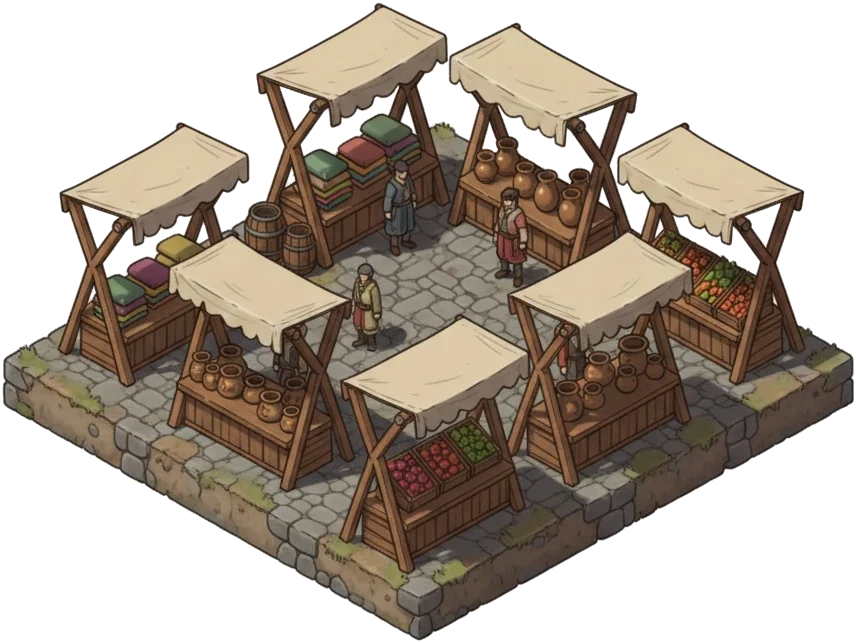
The Marketplace is where Governors barter directly with one another across the archipelago. A surplus of stone in one harbour can become the lumber another settlement desperately needs, provided merchant ships are ready to sail.
 Bazaar
 Guildhall
 Fleet
FleetBefore Trade Can Begin
A settlement must have a Marketplace constructed before its Governor may post or accept offers. Both buyer and seller require idle merchant ships in port, vessels already at sea cannot be committed to new contracts.
A seller's ships are not held back for an open offer; they may sail on other errands while it waits. But if a buyer comes for the offer and the seller has no hull in port to carry the cargo, the contract is struck from the board then and there. The cargo returns to the seller's stores, the seller receives a dispatch, and the buyer pays nothing. No coin changes hands, so a seller who wants the sale keeps a merchant in port while the offer stands.
Posting an Offer
A Governor posts an offer by naming what they wish to sell (a resource, a mineral or a good) and how much, and what they expect in return. The offered goods are reserved immediately, drawn from the settlement stores and held until the contract is fulfilled or withdrawn.
At the clerk's window, the current stores and coin reserve of the chosen settlement remain in view so the bargain can be judged before it is entered into the ledger.
How many open offers a settlement may keep depends on its Marketplace: one more berth for every level, never fewer than 3 and never more than 22. A level 1 Marketplace holds 3, level 5 holds 7, level 10 holds 12, and the full 22 arrive at level 20. The count is per island, so a Governor who trades from several harbours has berths at each. Offers remain on the board until another Governor accepts them or the seller withdraws. When another Governor accepts an open offer, the seller receives a dispatch at the Governor's Desk. With marketplace sales quieted in Desk Notices, it is filed under Showing: Quieted instead, already read. The payment arrives either way.
Accepting an Offer
- The buyer selects one of their settlements as the receiving port.
- The requested payment is deducted from the buyer's stores.
- The buyer also pays harbor dues in coins when the contract is sealed.
- Both sides commit merchant ships, one fleet carries payment to the seller, the other delivers the purchased goods to the buyer.
- When each fleet makes landfall, cargo is deposited into the receiving settlement's stores.
- Merchants return home once the delivery is complete.
A Governor cannot accept their own posted offer.
The Merchant Fleet
Every trade requires merchant ships. The harbour master assigns the most efficient combination of available vessels. Cargo is what counts, not the number of hulls: a harbour of small ships needs far more of them than a harbour of large ones for the same contract. The offer dialog shows how much your ships in port can carry against what the contract asks you to send.
| Vessel | Cargo | Speed |
|---|---|---|
| Small Merchant Ship | 80 | 1 |
 Large Merchant Ship Large Merchant Ship | 200 | 0.7 |
Finding a bargain
The open market lists the newest offers first. When the stalls are crowded, the line above them narrows the view: pick one item on sale to see only who is selling it, then order the offers by Nearest harbour or, once an item is chosen, by Cheapest. Cheapest groups offers by what each seller asks in return, so lumber for gold is ranked against lumber for gold, never against lumber for stone. Both orders weigh the whole board, not only the offers on screen: the board shows fifty at a time, and Show more reads the next fifty in the same order.
My Offers
The Market has two sub tabs. The Trade Board lists every other Governor's offers; My Offers lists your own. My Offers is kept for the Governor, not for a single settlement: every open offer appears there no matter which island it was posted from, each noted with its harbour of origin. From there a Governor may withdraw an offer at any time, from anywhere in the archipelago. Withdrawn goods return to the stores of the settlement that posted them, not to the island the Governor happens to be visiting.
A Governor may also change what an open offer asks for without withdrawing it. The cargo stays in escrow, and the offer keeps its place on the board and its seven days. A buyer who was still looking at the old price is shown the new one before anything is paid. Each change counts toward the same posting limit as a new offer, so a price cannot be flipped over and over to stay at the top of the board.
Minerals from the rocks can be sold on the board like any cargo, but never asked for: a price is always named in coins, gold, stone or lumber.
The Trade Ledger
The ledger records every completed trade and bazaar purchase, so a Governor can look back over past bargains. Offers still waiting for a buyer are under My Offers.
The Guildhall Counter
The same Marketplace that handles barter and bazaar trade now also opens the Guildhall counter. There, clerks sell timed name styles that alter how a Governor's name appears across the archipelago.
Current guildhall commissions concern identity, influence, and quiet schemes rather than cargo. A Governor may buy a title or decorative name style for a fixed term, or purchase a sealed anonymous letter that arrives at another Governor's desk as an unsigned dispatch.

Trade Fees
Marketplace contracts charge harbor dues in coins to the buyer when a deal is sealed. The seller still delivers the full offered cargo; no goods are shaved off in transit.
The buyer's own Marketplace reduces these dues. In the present world, the fee begins near 8% and falls by about 0.55% per Marketplace level, but never below 1.5%. A seller's Marketplace level decides something else: how many offers that island may hold open at once.
What decides whether a trade can sail?validation checks
Both ports need an eligible Marketplace, enough idle merchant capacity, enough resources for the promised cargo or payment, and enough buyer coins for harbor dues. If the seller's port has no hulls free when a buyer accepts, the contract is struck instead. Cargo is reserved when posted and committed when accepted.
The receiving storehouse still matters. Goods that arrive above storage capacity are lost, even if the contract itself was valid.
Prefer coin-based purchases over direct barter? Visit the Bazaar. To move goods between settlements under the same authority, see Fleet.
Common questions
Why can I not seal a trade?
The usual causes are no receiving settlement selected, insufficient payment, not enough coins for harbor dues, idle merchant ships missing from your port, or a fleet whose hulls cannot lift the payment in one sailing. The dialog names the shortfall and how many small ships would close it.
Why did an offer vanish from the board?
Another Governor may have accepted it, the seller may have withdrawn it, or the seven-day listing window may have expired. It is also struck when a buyer comes for it and the seller has no ships in port to carry the cargo. Withdrawn, expired and struck offers return the reserved goods to the seller.
Can a Guildhall commission replace normal diplomacy?
No. Titles and name styles change how a Governor is seen. Anonymous letters are one-use dispatches, not an ongoing message thread.